Amber Dennison
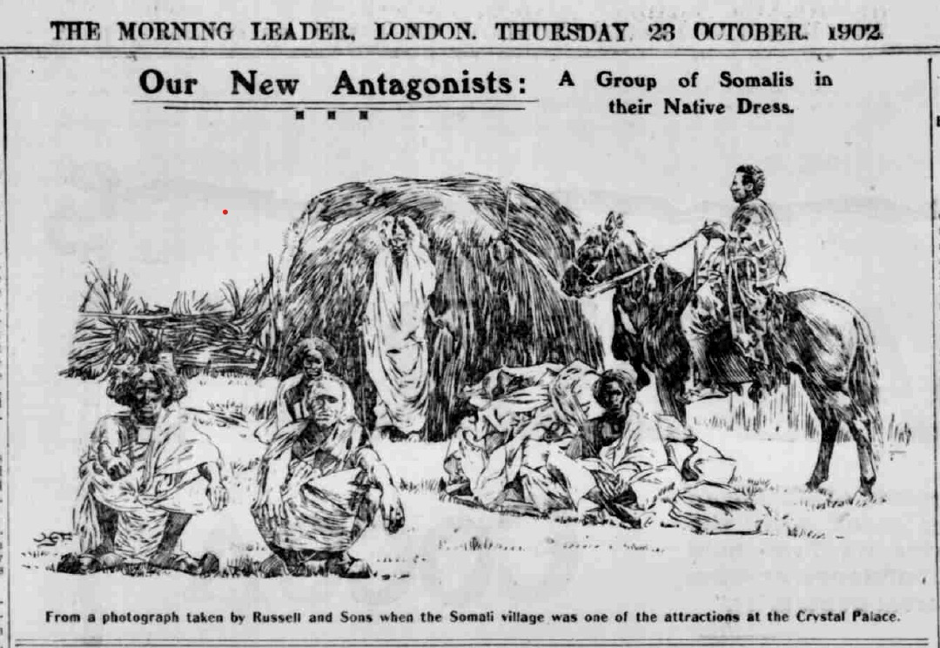
This 1902 illustration, published in The Morning Leader and titled “Our New Antagonists: A Group of Somalis in their Native Dress”, indicates how Somalis were represented to the British public at the same time as Yorkshire military personnel were engaged in operations in Somaliland. The caption states that the photograph was taken at Crystal Palace, where a “Somali Village” was displayed as a public attraction.[1] Such displays formed part of the wider imperial exhibitions of the period, which were designed both to educate and entertain the public. In this context, a complex anti-colonial resistance movement was reduced to a simplified “them versus us” narrative. While soldiers were engaged in colonial warfare, the British press and exhibition culture contributed to shaping public perceptions by presenting Somalis both as curiosities and friendly imperial subjects while also identifying them as “antagonists”. This example illustrates how cultural representation in ethnographic displays operated alongside military campaigns in the broader context of British imperialism.
This blog post examines the involvement of Yorkshire regiments in the first four British campaigns of the Anglo-Somali Wars, which took place between 1900 and 1904, although the conflict continued intermittently until 1920. These early Somaliland campaigns unfolded during a transitional period in which Britain was increasingly shifting its attention from colonial warfare towards the dynamics of European power politics (Blakeley, 2019). The campaigns were “amongst the last ‘Victorian’ colonial military expeditions undertaken by the British Empire” (Blakeley, 2019) and were conducted in response to the anti-colonial resistance of Muhammad Abdullah Hassan (1856–1920). Hassan was a prominent Somali religious and military leader whose opposition to British encroachment generated sustained conflict in Somaliland. The fighting formed part of a broader imperial strategy to contain the Dervish movement under Hassan’s leadership. Continuing intermittently until 1920, these early campaigns marked the beginning of repeated British expeditions and reflected both sustained Somali resistance and the wider difficulties encountered by the British imperial state (Blakeley, 2019).
During the early stages of the Anglo-Somali Wars, many British troops were committed to the Second Boer War (1899–1902), fought between the United Kingdom and the Boer republics of the Transvaal and the Orange Free State. As a result, imperial forces had to be drawn from across the empire to mount the campaign against the Dervishes. Alongside officers sent from Britain, troops from India, Aden and parts of Africa were also deployed (Blakeley, 2019). At the time, the Anglo-Somali Wars were not typically characterised as conventional wars, partly because of the rotating units and attachments deployed from across the British Empire. In Somaliland, British colonial warfare relied heavily on small detachments of regular soldiers rather than full regimental deployments (Slight, 2011). Soldiers from English county regiments, including Yorkshire’s, were therefore often seconded individually or in small detachments rather than in large numbers, situating their service within a broader imperial military system (Slight, 2011).
Further evidence can be found in a 1904 report published in The Yorkshire Post. The article recounts one of the British campaigns in the Anglo-Somali Wars and identifies several Yorkshire military personnel, noting that “a number of local officers are mentioned and recommended in despatches for the recent campaign in Somaliland” (The Yorkshire Post, 5 September 1904, p. 4). The report refers to the Fourth Campaign of 1903–4, which was led by Major-General Sir Charles Egerton, a Yorkshire general. Captain A.E. Hamerton of the Royal Army Medical Corps is recommended for special consideration; he had received his medical training at Leeds Medical School and later served as second surgeon at the Leeds Dispensary. The report also mentions two officers connected with the Leeds Territorial Corps: Captain T.N.S.M Howard for “good work” as a major of the King’s African Rifles, and Captain H.do.B. Codrington, “who is twice referred to”. In addition, it refers to Lieutenant-Colonel C.J. Melliss, V.C., identified as “an old East Yorkshire officer, the son of General Melliss and the son-in-law of the late General Walter C.B. Another military man, Captain Aplin, is presented as presumably an old “Snapper” officer, with service in the Afghan and Burmese campaigns. Captain L. Dess is identified as having formerly served in the Yorkshire Light Infantry, while Captain H.A. Lane is noted as having served in the “Canaries” – a well-known old York regiment. This source is particularly valuable because it demonstrates how imperial warfare was connected to Yorkshire communities through the recognition of her serving officers and their exploits in Somaliland.
A collection of medals awarded to members of the Yorkshire regiments provides further material evidence of Yorkshire troops’ involvement in the Anglo-Somali Wars. For example, a private of the 2nd Battalion, Yorkshire Regiment, received the Africa General Service Medal with the clasp “Somaliland 1902–1904”, directly linking the regiment to the colonial conflict. The Africa General Service Medal (1902‒1956) was issued specifically for British imperial campaigns in Africa, including operations against Hassan, who the British dubbed the “Mad Mullah” (Noonans, 2006).
The purpose of the campaigns was framed by British authorities as the restoration of order. According to A Short History of British Territorial Regiments, the Yorkshire Regiment was represented in the Somaliland Field Force by two officers and 60 men, who formed half of the British mounted infantry serving with it (Rudolf, 1905, p. 193). British operations in Somaliland were presented as necessary because the Dervish movement was said to threaten tribes under British protection. This framing allowed intervention to be justified as a defensive measure rather than as an act of aggression or expansion. In addition, British officials feared that, if left unchecked, the movement could threaten Britain’s alliance with Ethiopia and potentially produce another significant imperial defeat at the hands of a militant Sufi group, as had occurred in the Sudan (Blakeley, 2019). Hussein Bulhan, however, argues that colonial powers “imposed artificial borders” and military control over Somali territories (Bulhan, 2024). He contends that British regiments, including Yorkshire units deployed in Somaliland, functioned as instruments of the imperial system. Bulhan further argues that European powers divided the Horn of Africa without regard for the Somali people who lived there. Although Somalis shared in their homeland a common culture and language, colonial borders divided them across different territories, creating long-term political consequences. From this perspective, the Anglo-Somali Wars can be understood as part of the violent enforcement of colonial partition, rather than as isolated military campaigns. The participation of the Yorkshire Regiment therefore exemplifies Bulhan’s concept of the militarisation of colonial domination, in which European forces were used to suppress Somali resistance to foreign rule.
Endnotes
[1] In 1902, only one Somali ethnographic troupe had appeared in Britain to date, the first one that was staged at Crystal Palace in Sydenham, London, under the leadership of Hirsi Egeh Gorseh and the impresario Carl Hagenbeck. For more on this troupe and the wider phenomenon of Somali ethnographic shows in Europe see Warsame (2022).
References
Blakeley, D. (2019) ‘Britain, India, and the Somaliland Campaigns of 1901–04’, in Olmstead, J.Q. (ed.) Britain in the Islamic World: Imperial and Post-Imperial Connections. Cham: Palgrave Macmillan (Britain and the World), pp. 149–168. Available at: https://doi.org/10.1007/978-3-030-24509-2_7 (Accessed: 28 July 2026).
Bulhan, H.A. (2024) ‘Hussein Bulhan on the colonial partition of the Horn’, Geeska, 6 November. Available at: https://www.geeska.com/en/hussein-bulhan-colonial-partition-horn (Accessed: 28 July 2026).
Noonans (2006) A Collection of Medals to the Yorkshire Regiment (Green Howards) [Auction catalogue, sale of 5 April 2006]. London: Noonans. Available at: https://www.noonans.co.uk/archive/special-collections/250/ (Accessed: 28 July 2026).
Rudolf, R. de M. (1905) Short Histories of the Territorial Regiments of the British Army, Including the Names of the Officers and Soldiers who Have Won the Victoria Cross or the Distinguished Conduct Medal. London: His Majesty’s Stationery Office. Available at: https://archive.org/details/shorthistoriesof00rudouoft (Accessed: 28 July 2026).
Slight, J.P. (2011) ‘British and Somali Views of Muhammad Abdullah Hassan’s “Jihad,” 1899–1920’, Bildhaan: An International Journal of Somali Studies, 10(1), pp. 16–35. Available at: https://digitalcommons.macalester.edu/bildhaan/vol10/iss1/7 (Accessed: 28 July 2026).
Warsame, B, (2022) A Brief History of Staging Somali Ethnographic Performing Troupes in Europe, 1885–1930. In: D. Demski and D. Czarnecka, eds. Staged Otherness: Ethnic Shows in Central and Eastern Europe. Budapest: Central European University Press, pp. 77–100. Available at: https://www.degruyterbrill.com/document/doi/10.1515/9789633864401-004/html (Accessed: 30 July 2026).
Yorkshire Post and Leeds Intelligencer (1904) ‘Somali Expedition: Recognition for Yorkshire Officers’, 5 September, p. 4.
Amber Dennison produced this blog post as an output of her module FOAH2002 Student Research Partnerships, part of the BA in Liberal Arts at the University of Leeds, during a placement with the Somali Village in Colonial Bradford project in the academic year 2025–26.
 Somali Village
Leave a comment