University of Leeds students conduct research into the visual archive of Bradford’s Somali Village of 1904 during the academic year (2025-26). Photograph courtesy of Prof. Fozia Bora.
The Somali Village charity would like to highlight the work of five Leeds University students who were seconded to the Somali Village in Colonial Bradford project during 2025-26, which has seen the release of a schools pack for the whole Bradford District, and the launch of a six-month exhibition at Cartwright Hall.
Wool is often imagined as a traditional product associated with rural landscapes. However, research into Bradford’s industrial history shows that wool was deeply embedded within colonial networks. During the nineteenth century, the city developed from a small market town into the ‘wool capital of the world’, or ‘Worstedopolis’, a term coined by William Cudworth in 1888 (Bradford Museums & Art Galleries, 2022). The expansion of the wool trade enabled the Piece Halls to open in 1773 and supported the growth of textile commerce as larger trading centres developed (Bradford Museums & Art Galleries, 2022). These commercial spaces became important sites of exchange between manufacturers and international buyers, indicating that Bradford’s economy was extending beyond local markets.
In this blog post, I examine the significance of wool within Britain’s industrial development and consider how it can be understood as a colonial commodity within a wider global context. I also explore Bradford’s connections with overseas markets and consider how these relationships emphasise the city’s global significance.
Bradford’s rise as an industrial centre was closely connected to its geographical position and infrastructure. Poor roads initially limited development, making canals essential for moving coal, raw wool and finished cloth. These transport networks connected inland Yorkshire to London and overseas markets, enabling the circulation of raw materials and textiles (Rees, 1948, p. 28).
Transport and technological change were central to Bradford’s industrialisation. The opening of the Moline Mill on Thornton Road in 1798, Bradford’s first steam-powered textile mill, marked a transition towards factory-based manufacturing (Bradford Museums & Art Galleries, 2022). By the 1850s, two-thirds of Britain’s wool industry was concentrated in the Bradford region, providing approximately 70,000 jobs and employing one in three local workers (Bradford Museums & Art Galleries, 2022).
Bradford’s wool industry was also shaped by migration and international commercial networks. The arrival of German merchants in the 1830s contributed to the development of Little Germany, an area of warehouses and trading houses that strengthened Bradford’s role within global markets (Bradford Museums & Art Galleries, 2022). By the mid-nineteenth century, colonial wool, particularly from Australia, formed an increasingly significant proportion of Britain’s raw material supply (Bradford Museums & Art Galleries, 2022; Birt 2025). In 1831, Australia supplied 8% of Britain’s wool, but only twenty years later that had increased to half of a vastly increased total (Belich, 2009, p. 278, cited in Birt 2025). Although wool was often represented as a British rural product, Bradford’s success depended heavily on colonial agriculture, including large-scale Merino sheep farming in Australia. This demonstrates how industrial growth in Britain relied on overseas raw materials and on the relationship between agriculture, technology and imperial trade.
The organisation of the wool industry further illustrates Bradford’s global significance. Weld explains that woollen and worsted manufacture developed into highly specialised industrial processes, with stages such as combing, spinning and weaving sometimes carried out in separate mills (Weld, 1912, pp. 68–70). Large-scale production was therefore made possible by the capacity of British manufacturers to process substantial quantities of imported colonial wool. The industry also linked sheep farming, global trade and consumer markets into a single economic system, contributing to urbanisation, migration and industrial labour in cities such as Bradford. However, by the twentieth century, Bradford’s wool industry began to decline rapidly due to overseas competition and the increasing popularity of alternative clothing and fabrics (Bradford Museums & Art Galleries, 2022).
Understanding wool as a colonial commodity is therefore important for interpreting Bradford’s industrial history and its relationship to wider imperial narratives, including exhibitions. In particular, the concentration of worsted production in regions such as the West Riding of Yorkshire reinforced Bradford’s position as an international centre of textile manufacture.
How, then, does this relate to the Somali Village? This blog post has shown that Bradford’s industrial success was rooted in colonial systems. As the city grew wealthier by processing wool sourced through the empire, exhibitions used displays of colonised people to celebrate imperial success and industrial achievement. This research can therefore help the public understand how local history connects to wider global and colonial histories.
References
Belich, J. 2009. Replenishing the Earth: The Settler Revolution and the Rise of the Angloworld, 1783‒1939. Oxford: Oxford University Press.
Birt, Y. 2025. Bradford’s wool as a settler colonial commodity. Somali Village, 26 April. Available from: Somali Village [Accessed 30 July 2026].
Rees, H. 1948. Leeds and the Yorkshire woollen industry. Economic Geography, 24(1), pp. 28–34. [1]
Weld, L.D.H. 1912. Specialization in the woolen and worsted industry. The Quarterly Journal of Economics, 27(1), pp. 67–94.
Nancy Pilkington produced this work as an output of her module FOAH2002 Student Research Partnerships, part of the BA in Liberal Arts at the University of Leeds, during a placement with the Somali Village in Colonial Bradford project in the academic year 2025–26.
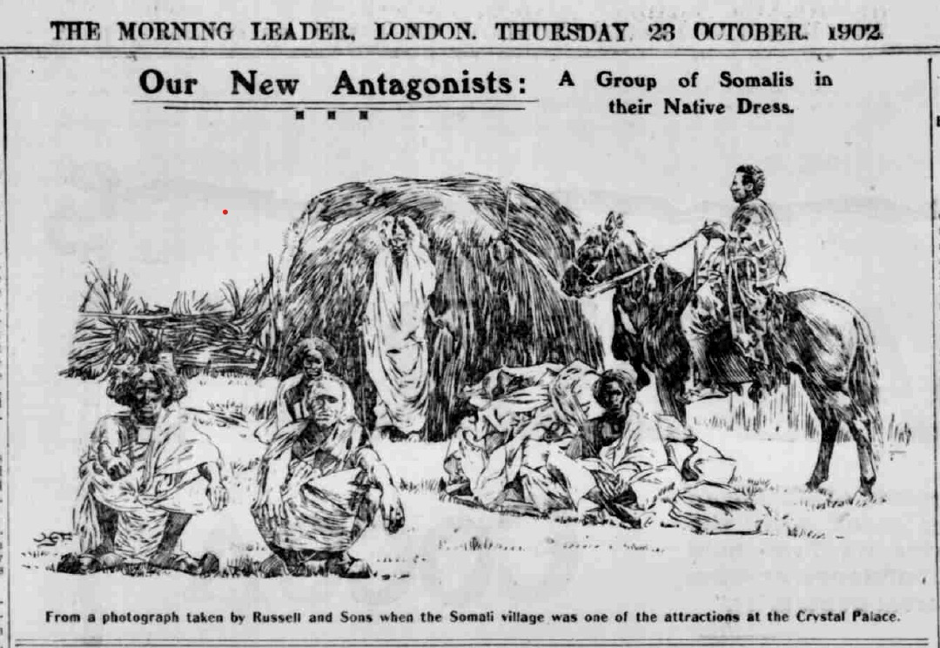
This 1902 illustration, published in The Morning Leader and titled “Our New Antagonists: A Group of Somalis in their Native Dress”, indicates how Somalis were represented to the British public at the same time as Yorkshire military personnel were engaged in operations in Somaliland. The caption states that the photograph was taken at Crystal Palace, where a “Somali Village” was displayed as a public attraction.[1] Such displays formed part of the wider imperial exhibitions of the period, which were designed both to educate and entertain the public. In this context, a complex anti-colonial resistance movement was reduced to a simplified “them versus us” narrative. While soldiers were engaged in colonial warfare, the British press and exhibition culture contributed to shaping public perceptions by presenting Somalis both as curiosities and friendly imperial subjects while also identifying them as “antagonists”. This example illustrates how cultural representation in ethnographic displays operated alongside military campaigns in the broader context of British imperialism.
This blog post examines the involvement of Yorkshire regiments in the first four British campaigns of the Anglo-Somali Wars, which took place between 1900 and 1904, although the conflict continued intermittently until 1920. These early Somaliland campaigns unfolded during a transitional period in which Britain was increasingly shifting its attention from colonial warfare towards the dynamics of European power politics (Blakeley, 2019). The campaigns were “amongst the last ‘Victorian’ colonial military expeditions undertaken by the British Empire” (Blakeley, 2019) and were conducted in response to the anti-colonial resistance of Muhammad Abdullah Hassan (1856–1920). Hassan was a prominent Somali religious and military leader whose opposition to British encroachment generated sustained conflict in Somaliland. The fighting formed part of a broader imperial strategy to contain the Dervish movement under Hassan’s leadership. Continuing intermittently until 1920, these early campaigns marked the beginning of repeated British expeditions and reflected both sustained Somali resistance and the wider difficulties encountered by the British imperial state (Blakeley, 2019).
During the early stages of the Anglo-Somali Wars, many British troops were committed to the Second Boer War (1899–1902), fought between the United Kingdom and the Boer republics of the Transvaal and the Orange Free State. As a result, imperial forces had to be drawn from across the empire to mount the campaign against the Dervishes. Alongside officers sent from Britain, troops from India, Aden and parts of Africa were also deployed (Blakeley, 2019). At the time, the Anglo-Somali Wars were not typically characterised as conventional wars, partly because of the rotating units and attachments deployed from across the British Empire. In Somaliland, British colonial warfare relied heavily on small detachments of regular soldiers rather than full regimental deployments (Slight, 2011). Soldiers from English county regiments, including Yorkshire’s, were therefore often seconded individually or in small detachments rather than in large numbers, situating their service within a broader imperial military system (Slight, 2011).
Further evidence can be found in a 1904 report published in The Yorkshire Post. The article recounts one of the British campaigns in the Anglo-Somali Wars and identifies several Yorkshire military personnel, noting that “a number of local officers are mentioned and recommended in despatches for the recent campaign in Somaliland” (The Yorkshire Post, 5 September 1904, p. 4). The report refers to the Fourth Campaign of 1903–4, which was led by Major-General Sir Charles Egerton, a Yorkshire general. Captain A.E. Hamerton of the Royal Army Medical Corps is recommended for special consideration; he had received his medical training at Leeds Medical School and later served as second surgeon at the Leeds Dispensary. The report also mentions two officers connected with the Leeds Territorial Corps: Captain T.N.S.M Howard for “good work” as a major of the King’s African Rifles, and Captain H.do.B. Codrington, “who is twice referred to”. In addition, it refers to Lieutenant-Colonel C.J. Melliss, V.C., identified as “an old East Yorkshire officer, the son of General Melliss and the son-in-law of the late General Walter C.B. Another military man, Captain Aplin, is presented as presumably an old “Snapper” officer, with service in the Afghan and Burmese campaigns. Captain L. Dess is identified as having formerly served in the Yorkshire Light Infantry, while Captain H.A. Lane is noted as having served in the “Canaries” – a well-known old York regiment. This source is particularly valuable because it demonstrates how imperial warfare was connected to Yorkshire communities through the recognition of her serving officers and their exploits in Somaliland.
A collection of medals awarded to members of the Yorkshire regiments provides further material evidence of Yorkshire troops’ involvement in the Anglo-Somali Wars. For example, a private of the 2nd Battalion, Yorkshire Regiment, received the Africa General Service Medal with the clasp “Somaliland 1902–1904”, directly linking the regiment to the colonial conflict. The Africa General Service Medal (1902‒1956) was issued specifically for British imperial campaigns in Africa, including operations against Hassan, who the British dubbed the “Mad Mullah” (Noonans, 2006).
The purpose of the campaigns was framed by British authorities as the restoration of order. According to A Short History of British Territorial Regiments, the Yorkshire Regiment was represented in the Somaliland Field Force by two officers and 60 men, who formed half of the British mounted infantry serving with it (Rudolf, 1905, p. 193). British operations in Somaliland were presented as necessary because the Dervish movement was said to threaten tribes under British protection. This framing allowed intervention to be justified as a defensive measure rather than as an act of aggression or expansion. In addition, British officials feared that, if left unchecked, the movement could threaten Britain’s alliance with Ethiopia and potentially produce another significant imperial defeat at the hands of a militant Sufi group, as had occurred in the Sudan (Blakeley, 2019). Hussein Bulhan, however, argues that colonial powers “imposed artificial borders” and military control over Somali territories (Bulhan, 2024). He contends that British regiments, including Yorkshire units deployed in Somaliland, functioned as instruments of the imperial system. Bulhan further argues that European powers divided the Horn of Africa without regard for the Somali people who lived there. Although Somalis shared in their homeland a common culture and language, colonial borders divided them across different territories, creating long-term political consequences. From this perspective, the Anglo-Somali Wars can be understood as part of the violent enforcement of colonial partition, rather than as isolated military campaigns. The participation of the Yorkshire Regiment therefore exemplifies Bulhan’s concept of the militarisation of colonial domination, in which European forces were used to suppress Somali resistance to foreign rule.
Endnotes
[1] In 1902, only one Somali ethnographic troupe had appeared in Britain to date, the first one that was staged at Crystal Palace in Sydenham, London, under the leadership of Hirsi Egeh Gorseh and the impresario Carl Hagenbeck. For more on this troupe and the wider phenomenon of Somali ethnographic shows in Europe see Warsame (2022).
References
Blakeley, D. (2019) ‘Britain, India, and the Somaliland Campaigns of 1901–04’, in Olmstead, J.Q. (ed.) Britain in the Islamic World: Imperial and Post-Imperial Connections. Cham: Palgrave Macmillan (Britain and the World), pp. 149–168. Available at: https://doi.org/10.1007/978-3-030-24509-2_7 (Accessed: 28 July 2026).
Noonans (2006) A Collection of Medals to the Yorkshire Regiment (Green Howards) [Auction catalogue, sale of 5 April 2006]. London: Noonans. Available at: https://www.noonans.co.uk/archive/special-collections/250/ (Accessed: 28 July 2026).
Rudolf, R. de M. (1905) Short Histories of the Territorial Regiments of the British Army, Including the Names of the Officers and Soldiers who Have Won the Victoria Cross or the Distinguished Conduct Medal. London: His Majesty’s Stationery Office. Available at: https://archive.org/details/shorthistoriesof00rudouoft (Accessed: 28 July 2026).
Slight, J.P. (2011) ‘British and Somali Views of Muhammad Abdullah Hassan’s “Jihad,” 1899–1920’, Bildhaan: An International Journal of Somali Studies, 10(1), pp. 16–35. Available at: https://digitalcommons.macalester.edu/bildhaan/vol10/iss1/7 (Accessed: 28 July 2026).
Warsame, B, (2022) A Brief History of Staging Somali Ethnographic Performing Troupes in Europe, 1885–1930. In: D. Demski and D. Czarnecka, eds. Staged Otherness: Ethnic Shows in Central and Eastern Europe. Budapest: Central European University Press, pp. 77–100. Available at: https://www.degruyterbrill.com/document/doi/10.1515/9789633864401-004/html (Accessed: 30 July 2026).
Yorkshire Post and Leeds Intelligencer (1904) ‘Somali Expedition: Recognition for Yorkshire Officers’, 5 September, p. 4.
Amber Dennison produced this blog post as an output of her module FOAH2002 Student Research Partnerships, part of the BA in Liberal Arts at the University of Leeds, during a placement with the Somali Village in Colonial Bradford project in the academic year 2025–26.
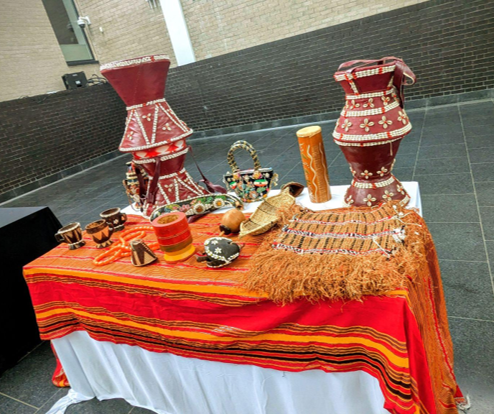
Photograph of textiles similar to those made by the Somalis in 1904. Taken in October 2025. By: Somali community of Cardiff.
In its first month of opening, the Yorkshire Factory Times carried a review of Bradford’s Great Exhibition of 1904, which focused upon how competently it sold the city as a global leader in industrial innovation, especially in its largest industry of textile production. As an aside, the review provided a throwaway comment on the presence of a handloom in the Somali Village, the most popular entertainment at the Exhibition:In its first month of opening, the Yorkshire Factory Times carried a review of Bradford’s Great Exhibition of 1904, which focused upon how competently it sold the city as a global leader in industrial innovation, especially in its largest industry of textile production. As an aside, the review provided a throwaway comment on the presence of a handloom in the Somali Village, the most popular entertainment at the Exhibition:
The hand loom in the exhibition weaving cloth goods is a novelty, but is that and nothing more, as is also the spinning wheel, with its combed wool spun into weft. The loom in the Somali portion, if a correct method of weaving as carried on in the black districts, won’t cause foreign competition to teach us to put tariffs on.[1]
Contemporaneous Somali hand-weaving was dismissed as part of the old world that Britain had left through industrial innovation, as a quaint novelty that had no relevance to the hard-nosed world of technology and business. In the rest of this blog, I shall set out to challenge this casual and racializing dismissal.
The practice of Somali hand-weaving brings together music, art, practicality and heritage. Precisely because of this hybridity, I argue, it also posed a threat to the British Empire’s attempt to present African cultural production as static, primitive or inferior. By examining the historical treatment of hand-weaving, while also challenging its current perception as an archaic folk art, we can better understand the relationship between Somalia’s colonisation and the cultural practices that are now at risk of being lost to members of the diaspora. In this context, the juxtaposition between hand-weaving in the 1904 Somali Village and the textile machines displayed in the Industrial Hall becomes symbolic of the unequal relationship between Britain and its imperial subjects.
To begin with, the historical significance of weaving in Somalia has been largely ignored in academic research. This neglect helps obscure the impact that the decline of Somali textile exportation had on the country’s economic and cultural identity. As Clarence-Smith states,
the Benadir coast of Somalia had an ancient reputation as an exporter of cotton textiles. Back in the fourteenth century, Ibn Battuta noted that the “unequalled” cloth of Mogadishu was exported “to Egypt and elsewhere.”[2]
This history shows that Somalia’s role in textile production has been systematically disregarded. Such disregard reflects a wider colonial framework in which African products are valued only when they can be extracted, appropriated or reinterpreted through European systems of knowledge and production. Britain benefited from processes perfected over centuries in Somalia while also contributing to the removal of resources and labour that could have supported Somalia’s own technological development. As factory methods came to dominate global textile production, hand-weaving was increasingly pushed aside and associated with a supposedly pre-modern past. In this way, the 1904 exhibition, which featured the Somali Village in juxtaposition to the Industrial Hall, helped justify British imperialism to white audiences through the display of technological advancement.
This contrast was especially visible in the relationship between the Somali Village and the wider 1904 Bradford Exhibition. Hattersley’s, based in Keighley, invented, patented and manufactured the “self-shuttling” loom in 1901, before its introduction into the Industrial Hall at the 1904 Bradford Exhibition.[3] By placing Somali hand-weaving in the Village alongside such industrial advances, the exhibition encouraged visitors to read Somali labour as slow, manual and inferior. Yet this framing ignores the historical and cultural importance of hand-weaving, as well as the performers’ own skill and labour. They built the village by hand and sustained a community in a completely new environment in Bradford for six months. The contrast between the Somali Village and the Bradford Exhibition was therefore not neutral: it shaped, and was shaped by, Britain’s colonial view of Africa and its people.
A further dimension of this erasure is the role of women in hand-weaving. The hand-weaving exhibited in the Somali Village would likely have been undervalued and treated as folk art to be viewed with patronising wonder. This dismissal was intensified by the fact that, in Somalia, most hand-weaving is traditionally done by women. When positioned against the industrial, scientific and technological – and therefore, by extension, male – achievements displayed in the 1904 Exhibition, Somali hand-weaving could be reduced to a women’s pastime rather than recognised as skilled cultural production:
In a jointly sponsored UNESCO and UNICEF report on a seminar held in April 1978 in Mogadishu on Basic Education for Nomads, “[..] Arts and Crafts among the Somali nomads centre on wood carving; camel bells, wooden spoons, forks, dishes, walking sticks etc.” It is interesting that the arts and crafts of which the author Abdi Arte speaks are woodcarving, the one and only craft executed by men.[4]
The failure to recognise objects made by women therefore reproduces two forms of hierarchy at once. It privileges Western technology over Somali craft, and it privileges male-made objects within Somali cultural history over the work of women. As a result, the strength, knowledge and skill of women weavers are pushed out of view, allowing hand-weaving to be framed as a historical craft left behind by Western progress rather than as a living and complex cultural practice in its own right.
At the same time, hand-weaving in the Somali Village may also have helped connect the performers to the homes they had left behind. However, this cultural connection was complicated by the commercial setting of the exhibition, where the troupe sold their handmade items to visitors. This created a tension between hand-weaving as a practical and cultural practice and hand-weaving as a performance for a white audience looking on from a position of power. Demonstrating a cultural activity for the coloniser intensified the white gaze and turned Somali labour into entertainment for the crowd. As bell hooks argues,
Often in contemporary capitalist society, where “folk art” is an expensive commodity in the marketplace, many art historians, curators, and collectors still assume that the folk who created this work did not fully understand and appreciate its “aesthetic value”.[5]
This is significant because hand-weaving was not simply a visual or material practice. Songs would have been sung while weaving in the aqal, a nomadic home traditional to the Somali people. These intertextual qualities show that hand-weaving brought together sound, movement, labour and memory. They also highlight the cultural richness of a practice that has been almost lost for many living members of the diaspora.
To conclude, restoring hand-weaving both as a practical technological process and a form of cultural history cannot undo Britain’s role in helping to erode this traditional Somali practice. However, it can offer a starting point for recovering its significance. Current projects that centre Somali voices and diasporic experiences are now exploring how this history can be expressed through the multifaceted process of hand-weaving. For the Somali people in Bradford’s staged village, hand-weaving may have been an essential expression of culture: a way of sustaining material, spiritual and communal connections while living for six months in a hostile environment. Fozia Ismai’s projects have been invaluable in developing artistic approaches to the historical significance of hand-weaving:
Our latest project Audible Tapestries has allowed us to research Somali nomadic weaving techniques and tactile technologies that can be incorporated into. Conventionally, all weaving is done by women in Somali nomadic life, from the creation of the Aqal (a portable house) to almost all of the household objects within it.[…][6]
The Somali Village charity also contributes to this process of recovery by preserving and curating evidence of hand-weaving. Its exhibition at Cartwright Hall aims “to commemorate the history and heritage of the Somali diaspora in the physical landscape.”[7] Together, these projects suggest that hand-weaving should not be understood as a relic of the past, but as a continuing practice through which Somali history, gendered labour and diasporic memory can be made visible again.
Orlagh McSorley produced this blog post as an output of her module FOAH2002 Student Research Partnerships, part of the BA in Liberal Arts at the University of Leeds, during a placement with the Somali Village in Colonial Bradford project in the academic year 2025–26.
[2] William Gervase Clarence-Smith, ‘Locally produced textiles on the Indian Ocean periphery 1500‒1850: East Africa, the Middle East, and Southeast Asia’, Global Economic History Network, (2006), p. 20.
[3] Eugene Joseph Nykolyszyn, ‘Innovation, diffusion and technology change. A study of the Yorkshire worsted industry (1890-1939)’, PhD thesis, University of Leeds, (2022), p. 93.
[4] Arlene Fullerton and Amina Ada, Handicrafts of the Nomadic Women of Somalia. (Smithsonian Libraries African Art Index Project, 1995), p. 2.
[5] bell hooks, Yearning: Race, Gender and Cultural Politics. (Boston: South End Press, 1990).
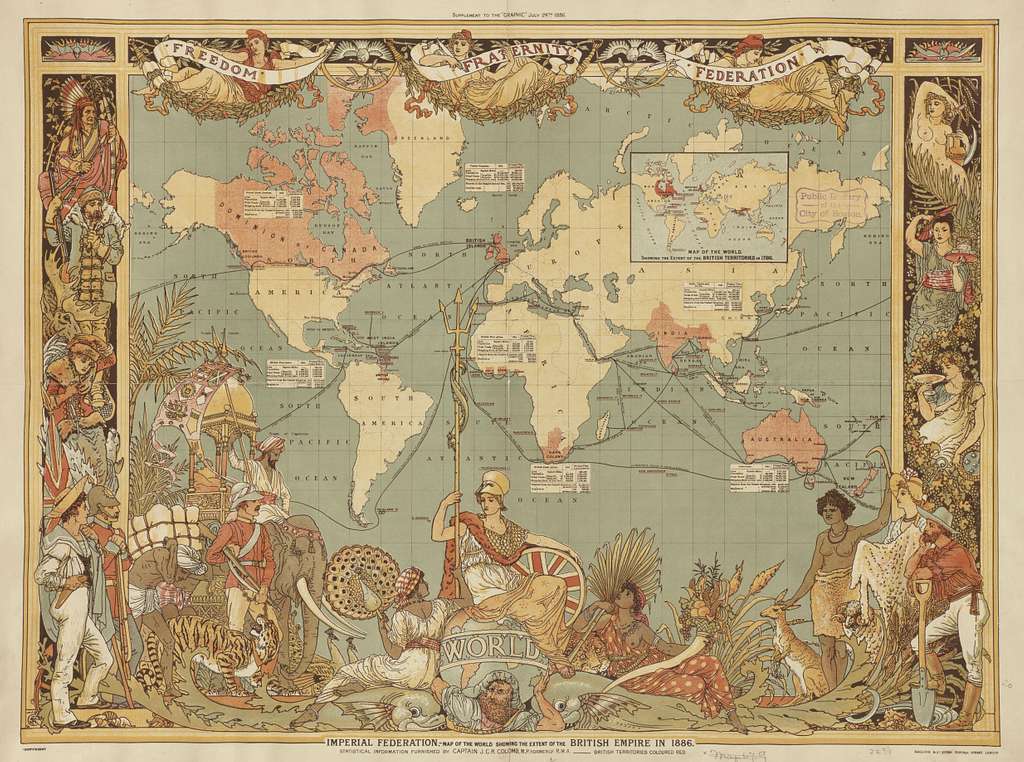
Imperial Federation, Map of the British Empire in 1886. Source: Picryl, under a Creative Commons licence.
Missionary work has long functioned as a means through which influence, recognition, and authority could be projected beyond local and national boundaries. Although this is often understood in relation to large denominations or imperial states, it was also significant at a regional level, enabling local communities to participate in, and derive status from, global missionary networks.
In the early stages of researching this blog post, I was struck by the kinds of material that dominated both academic research and online search results. Yorkshire’s missionary “successes”, including influential individuals and prominent organisations, were relatively easy to locate. By contrast, the more uncomfortable dimensions of Christian missions, colonial legacies, and imperial exhibitions proved far less visible. As with many aspects of historical memory, difficult subjects are often obscured, allowing societies to forget and move on rather than confront and process them fully. As Zeger Verleye argues, colonial shame or guilt can threaten the security of a nation’s self-identity (2021, p. 5). Given the historical and continuing significance of Christianity within Britain, it is unsurprising that a topic capable of destabilising so central an element of British identity has often been marginalised.
This tension between colonial guilt and Yorkshire’s involvement in Christian missions has led me to frame my research through the connected concepts of pride and shame. In her study of Christianity and colonialism, Hilary Carey identifies competition as one of the key reasons why ordinary people supported colonial missions (2011, pp. 17, 83, 379). She argues that denominations and nations sought to present themselves as especially powerful or influential, and this framework can also be applied to regions such as Yorkshire. As attitudes have shifted in the present, it is no longer possible to place uncritical pride in colonial missions. Instead, I argue that new forms of local pride have emerged through missionary work, centred on ethical practice, innovative thinking, and local origins. Yet, while these positive outcomes matter, they must be understood alongside the colonial legacies that helped to produce them.
This blog post therefore examines some of the key positive outcomes that Christian missions brought to Yorkshire, considering how they have been presented in ways that continue to reinforce local pride. It also addresses the less visible dimensions of missionary activity, arguing that these have received less public attention because they are bound up with colonial shame.
Individuals were central to Yorkshire’s role in Christian missions because they enabled the region to establish a presence within wider missionary networks. In doing so, they generated local recognition and pride for the communities from which they came. Their achievements were often reported in local newspapers, where they were presented as causes for communal celebration. William Dawson (1771‒1841), born in Garforth near Leeds, was a Yorkshire farmer and colliery steward who became a prominent lay preacher. Funds were raised to allow him to become a full-time preacher in 1837, with much of his work directed towards the support of foreign missions (Lowther, 1900, p. 229). This was undertaken with the hope that ‘his usefulness [would] be increased, and extended to every part of the land’ (Christian Retrospect, 1836, p. 311). For a small town, the ability to claim a connection to the London missionary scene and to participate indirectly in global mission would have been highly significant.
Individuals could also create enduring local legacies. James Hudson Taylor (1832‒1905), for instance, is regarded as a pioneering figure in the history of missionary work. Originally from Barnsley, Taylor founded the China Inland Mission in 1865, which Lam argues established a model for later missionary practice (2016, p. 1). He has since become a major source of local pride, appearing in newspaper articles and commemorated through cultural landmarks such as walking tours and blue plaques (Barnsley Chronicle, 2018; James Hudson Taylor, 2018; BBC South Yorkshire, 2012).
Missionary organisations similarly enabled local communities to establish enduring global connections and expand their influence. For example, the Starbeck Mission, founded in Harrogate in 1886, began as a local mission and today undertakes missionary work across Africa and Asia (Starbeck Mission). Such organisations often developed from local initiatives into globally active institutions. Their capacity to gain support within a community and use that support to pursue wider aims demonstrates how local areas could cultivate a shared sense of pride and purpose through global engagement. This phenomenon has continued beyond the formal decolonisation of the British Empire in the mid-twentieth century. Consequently, when these missions are understood as sources of local pride today, it is essential to acknowledge and critically reflect upon their colonial origins rather than allowing them to remain obscured.
In the Victorian period in particular, missions generated local pride not only through the work of missionaries themselves but also through their significance within community life. Missionary ideals were embedded in popular and educational culture across age groups. For example, Sabine Baring-Gould (1834‒1924) wrote hymns and songs such as “Now the Day is Over” and “Onward Christian Soldiers” for children at a missionary school in Yorkshire, both of which emphasised themes of duty and purpose (Hahn, 2015). Mission was therefore woven into everyday life, including education, and helped to foster a shared sense of communal purpose.
A less publicised aspect of this popular culture, however, was the public promotion and display of missionary activity. Missionary exhibitions became part of popular culture by presenting missions in ways that justified their aims and fostered positive public attitudes towards them. Although the evidence is somewhat limited, exhibitions displayed artefacts from countries visited by missionaries, including The Great Missionary Exhibition in Sheffield (1901) and Africa and the East in Bradford (1925) (National Trust, n.d.; Anon, 1925). Groten (2019) argues that such exhibitions formed part of a wider culture of imperial propaganda that represented those encountered by missionaries as uncivilised. Despite this, Meyer and Pels (2025) note that missionary collections and exhibitions have received comparatively little attention within scholarship on the displacement of objects during colonialism.
This context is significant for understanding the Somali Village. This blog post has sought to provide further background to the colonial setting of Yorkshire in which the Somali Village took place. Religion was an important tool for legitimising Britain’s imperial role, often framing it as a “civilising” mission. For example, Muhammad ibn Abdullah Hassan (1856‒1920), the anti-colonial leader and religious scholar, was represented as uncivilised and threatening to British imperial interests; by contrast, the Somali Villagers in Lister Park were depicted as loyal colonial subjects.
Religion also played a significant role in the Somali Village, with religious practice heavily emphasised in both the exhibition and press coverage. This emphasis was likely shaped by the perception of Somali religious practice as a subject of curiosity or spectacle within a predominantly Christian national context. As Freya Duncan (2025) argues, media representations of religion were carefully constructed to create distance between observers and the Somali people, while also identifying selected points of similarity. This dynamic was also reflected in the emphasis that the Somalis themselves placed on similarities between Islam and Christianity during press coverage of a Friday prayer service at the Village on 21 May 1904. The carefully curated lens through which the Somali people, and particularly their religion, were presented as inferior was integrally connected to how colonial Christianity was justified, viewed, and represented as a civilizing mission.
Religion and mission therefore also functioned as mechanisms of legitimacy and justification. Mwombeki argues that “colonialism and Christian mission had a symbiotic relationship”, in which each served the interests of the other, with missions supporting colonialism and colonialism facilitating the expansion of missions (2025, p. 390). Mwombeki’s argument can be extended to the Somali Village, where colonialism and ethnographic display in the context of religious differences may also be understood as operating in a similarly symbiotic relationship.
Primary Sources
Anon 2008. Life in Edwardian Tickhill: based on extracts from The Parish Magazines, Tickhill and District Local History Society, 5, pp. 1‒23.
Anon 1925. ’Africa and the East’ : C.M.S. Missionary Exhibition, Drill Hall, Manningham, Bradford, October 7th to 21st, 1925. Bradford: H.H. Tetley.
Hahn, D. 2015. BARING-GOULD, Sabine (1834-1924). The Oxford Companion to Children’s Literature. [Online].
Groten, M. 2019. Difference Between the Self and the Heathen. European Imperial Culture in Dutch Missionary Exhibitions, 1909–1957. The Journal of Imperial and Commonwealth History. [Online]. 47(3), pp. 490‒513. [Accessed 20 March 2026]. Available from: https://doi.org/10.1080/03086534.2018.1539725
Lam, J. 2016. From Holy Striving to Wholly Abiding: Mystical Transformation in James Hudson Taylor (1832-1905). HTS Teologiese Studies/Theological Studies. [Online]. 72(4), pp. 1–7. [Accessed 20 March 2026]. Available from: http://dx.doi.org/10.4102/v72i4.3483
Lowther, W.M. William Dawson. Dictionary of National Biography. 1885-1900, 14, p. 229
Meyer, B & Pels, P. 2025. Unpacking Missionary Collections. Material Religion. [Online]. 21(3), pp. 231‒243. [Accessed 20 March 2026]. Available from: https://doi.org/10.1080/17432200.2025.2505307
Mwombeki, F. 2024. The Berlin Conference: A Landmark in the Relationship between Colonialism and Mission in Africa. International Review of Mission. [Online]. 113(2), pp. 390‒404. [Accessed 11 March 2026]. Available from: https://doi.org/10.1111%2Firom.12516
Verleye, Z. 2021. The Lumumba Commission (1999-2002): Shame, Guilt, and the Post-Imperial Self. Journal of International Studies. [Online]. 50(1), pp. 3‒28 [Accessed 11 March 2026]. Available from: /doi.org/10.1177/0305829821105
Ellie Boyce produced this blog post as an output of her module FOAH2002 Student Research Partnerships, part of the BA in Liberal Arts at the University of Leeds, during a placement with the Somali Village in Colonial Bradford project in the academic year 2025–26.
As the world’s first UNESCO City of Film, Bradford has a significant heritage as a centre of film production (Bradford City of Film, 2008). Cinema’s role in shaping public perception is well established. As the pervasive racism of early Hollywood receives greater attention, scholars have also increasingly examined the racist and colonial tones of early British and European cinema (see Deroo and Fournié, 2011). Bradford’s 2008 bid for recognition as a City of Film openly acknowledged cinema’s colonial links. It noted, for example, the government-run Imperial Film Company’s operation from Bradford Town Centre Offices, local screenings of its films, and the ways films of Bradford captured twentieth-century colonial symbolism, for example, Mitchell and Kendall’s famous recording of the 1902 Coronation Procession, featuring wagons representing India and Canada (Bradford City of Film, 2008; Smith, 2026a). It also acknowledged the legacy of the less well-known media that helped shape early cinema’s colonial content, the “magic lantern slides”, which were also an influential medium in their own right (De Weerdt, 2023).
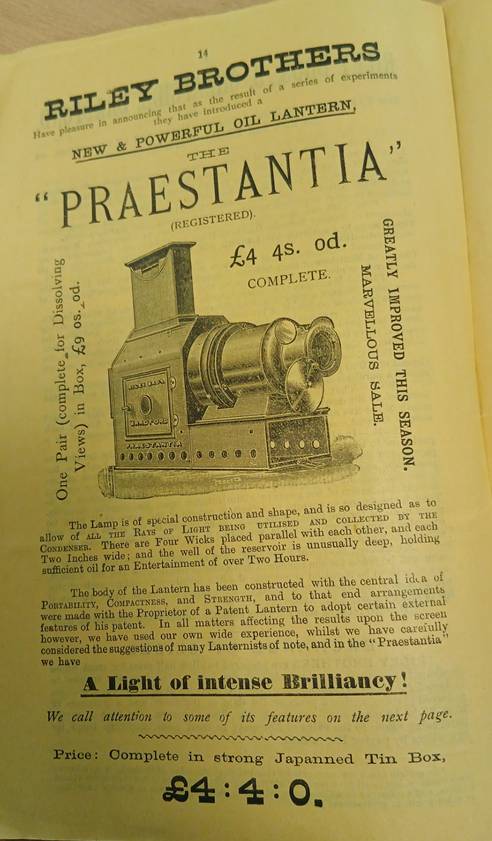
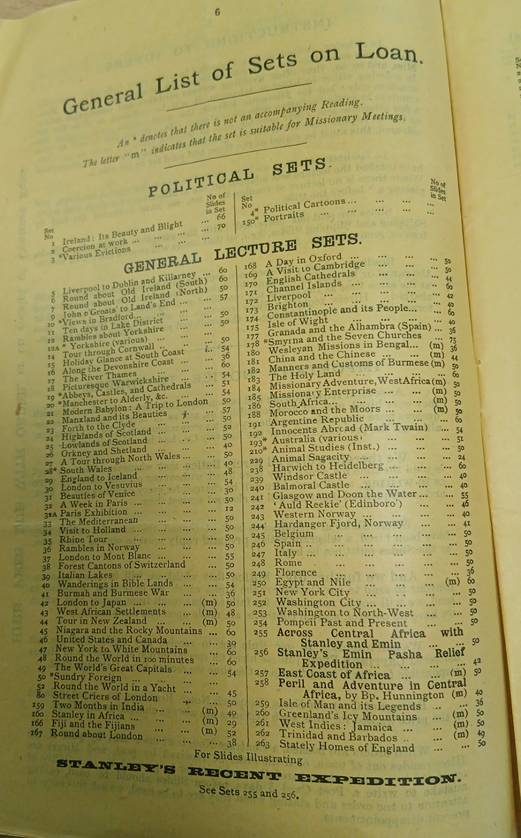
West Yorkshire Archives. 61D95/14/ box1/23 -Riley Brothers, Cheapside, Bradford, hire list of magic lanterns and lantern slides [1890]
Developed in the seventeenth century, magic lanterns were projectors that enabled small glass slides to be shown to a large audience (De Weerdt, 2023). Originally used for religious instruction, they later became a versatile and diverse medium, used as stand-alone entertainments and to illustrate lectures in a variety of settings, from churches and schoolrooms to music halls and fairgrounds, often blurring the boundaries between entertainment and education in both the presenter’s intent and the audience’s reception (De Weerdt, 2023; MacKenzie, 1984). This diversity made magic lantern slides easy to adapt to a variety of colonial purposes: dioramas of colonised places promoted emigration; images of “primitive” peoples illustrated missionary appeals and meetings; and entertainments could draw on racist humour and colonial adventure narratives, all of which created a blueprint for the presentation of colonialism in later cinema (MacKenzie, 1984).
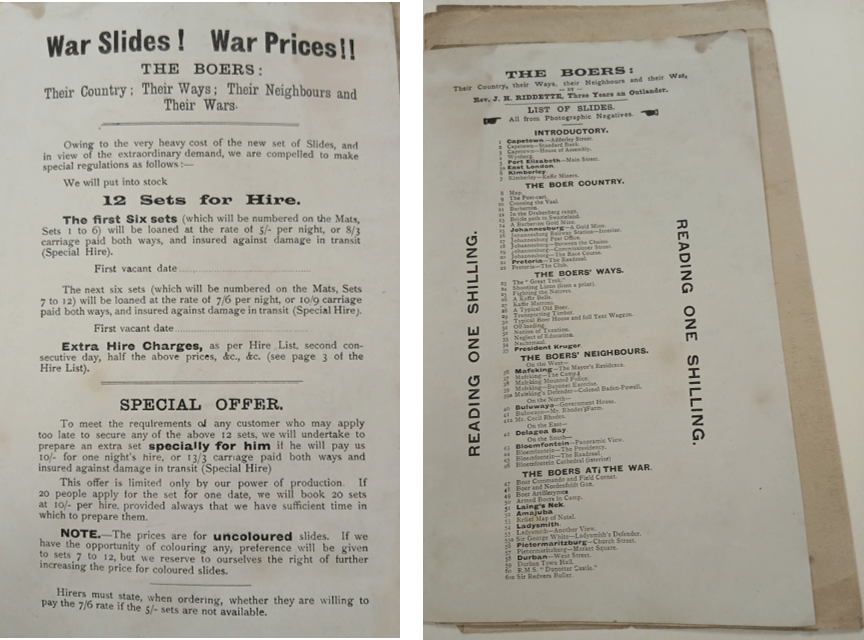
West Yorkshire Archives. 69D75/1 – Advertisement for Boer War lantern slides by Riley Brothers Limited of Bradford,1899
Bradford not only hosted such magic lantern shows, but was a centre for their production and distribution. Bradford was home to the Riley Brothers, a successful magic lantern company which rented slide sets, magic lanterns, and accessories to the public, claiming to have the world’s largest collection of slide sets (Bradford City of Film, 2008). Keen to meet public demand for information and entertainment related to colonial warfare, the company commissioned new slide sets on South Africa and the Boer Wars in 1899 (Riley Brothers, 1899). Bradfordians’ continued interest in the Boer Wars and South Africa can be seen in later, more public spectacles, such as the Savage South Africa Show in 1901, the Coronation celebrations in 1902, and the Buffalo Bill show in 1903 (Smith, 2026a, 2026b).
Although magic lanterns clearly shaped popular understandings of colonialism and contributed to the development of cinema, their distinctive role in religious and educational contexts also deserves emphasis. The Riley Brothers’ business demonstrates magic lanterns’ continued association with religion and education. Missionaries were among their target customers. Their catalogue marks slide sets as suitable for missionary meetings with an “M”, and they created a cheap loan system to encourage more rentals from religious organisations (Riley Brothers, 1890). Ellie Boyce (2026) has written on the importance of missionary work in Bradford’s links to colonialism, demonstrating the significance of magic lantern slides to Bradford’s colonial links beyond their relationship on cinema. The Riley Brothers also catered to educational institutions, offering to support teachers in finding lecturers to deliver their slides, and had educational sets explaining the colonial provenance of tea (Riley Brothers, 1890). MacKenzie (1984) argues that education about everyday objects was seen as a way to encourage children to recognise the Empire’s importance in their daily lives. The Riley Brothers’ emphasis on missionary work and education demonstrates the significance of the magic lantern in diffusing imperial doctrines beyond its contribution to cinema.
West Yorkshire Archives. 61D95/14/ box1/23 -Riley Brothers, Cheapside, Bradford, hire list of magic lanterns and lantern slides [1890]
Magic lantern slides helped to reinforce different colonial projects in Bradford and further afield, rallying (already enthusiastic) support for the Boer Wars and supporting colonial missionary work and children’s education on the British Empire. This distinct contribution should be considered alongside magic lanterns’ role in the development of cinema, and the wider connection between visual culture and empire that Bradford has rightly acknowledged (De Weerdt, 2023, Bradford City of Film, 2008).
Deroo, É. and Fournié, P. 2011. ‘From postcard to cinematograph: inventing reality’, in Blanchard, P. et al (eds.) Human zoos: science and spectacle in the age of colonial empires. Liverpool: Liverpool University Press, pp. 287–296.
MacKenzie, J.M. 1984. Propaganda and Empire: The Manipulation of British Public Opinion, 1880-1960. Manchester University Press.
Riley Brothers. 1890. Season 1890-91 Hire List. Magic Lanterns and Lantern Slides From Riley Brothers.
Riley Brothers. 1899. War Slides! From Riley Bros. Ltd. Bradford. [Advert].
With thanks to the West Yorkshire Archive Service, Bradford, for permission to republish these images.
Rowanne Smith studies Liberal Arts at the University of Leeds, majoring in Philosophy. Born and raised in West Yorkshire, the story of the Somali Village is close to home for her.
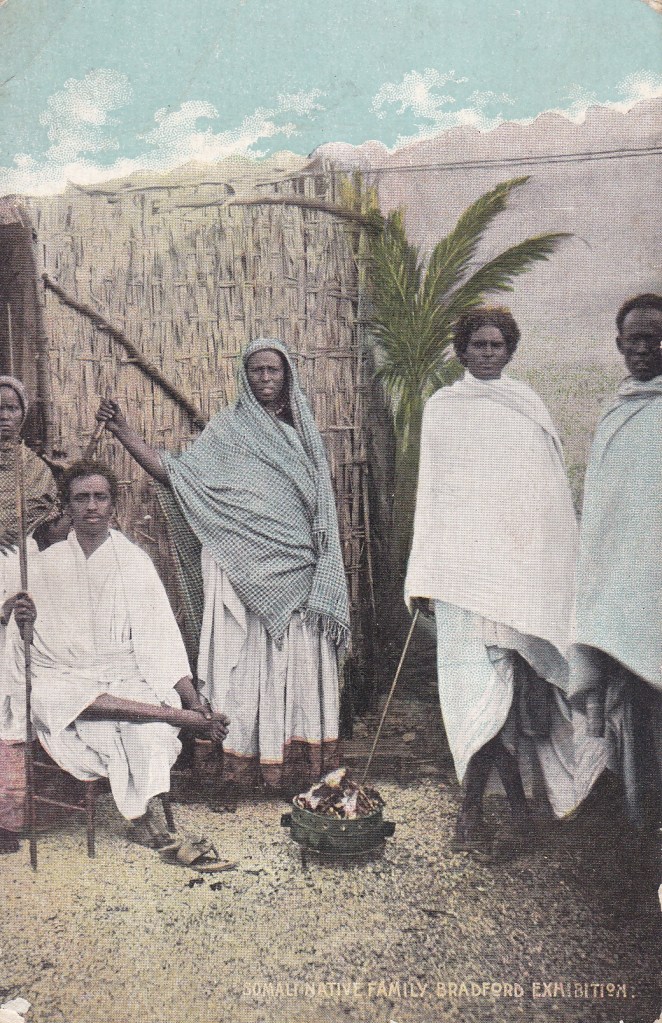
Staged here as a native Somali family in the Bradford Exhibition, they were also transnational workers in a system of imperial labour relations. Courtesy of the Yahya Birt collection.
The story of the Somali workers’ trip to Yorkshire reaches far back into the colonial history of Europe and Africa, and all the way forward into the lives of migrants in Bradford today. In trying to weave this story, I’ve found myself pulled down snickets, sidetracked into obscure ginnels of history. The traces left behind by the 57 Somali workers demonstrate a certain proud agency in surviving exploitative employment.
I must start this story of migration somewhere, and I’d rather start it with Hersi Egeh Gorseh than yet another white male coloniser. Gorseh was a Somali tribal chief who, in collaboration with German businessmen, recruited Somali performers for an 1895 ethnographic show in Hamburg. He was paid well for this work, and became lifelong friends with some of his European colleagues. He recruited performers from his inner circle, and for years this troupe travelled around Europe, honing their skills. Bodhari Wasame, a Somali researcher within this project, suggests many reasons for individuals to have undertaken these journeys; to earn more than at home, to see the world, to represent Somali heritage and warriorship.[1] Hersi Gorseh, in pioneering these tours, ended up with the name “Hersi Arwo” – a Somali word meaning “exhibition”, which in turn gave its name to the distinct profession of the Arwo, spelt “Carwo” in Somali, or “the people of the fair”.
This said, I do not want to downplay the colonialism that landed the Somali troupe in Bradford – the popular phrase “we’re here because you were over there” was as true in 1895 as it is today. Europeans were fascinated by the so-called “colonies”, an interest that sparked this recruitment for wildly successful ethnographic shows, including Bradford’s 1904 Exhibition. This speaks to the experience of so many migrants. The West promises travel and work, while exploiting the labour of those whose homelands have already been exploited. 18.7% of Bradford’s population today is non-UK born,[2] and many of these same complex motivations may have drawn them to the city, both the allure of a better life and the neo-colonialism that exploits migrant workers.
Once the troupe made it to Bradford, they joined the enormous workforce running the Great Exhibition at Lister Park. As the compound they lived in was open to the public, everyday tasks like washing and cooking were as much a part of the show as the spear throwing demonstrations the villagers performed. The voices of the troupe are missing from the archive, but it is easy to imagine how, as Bodhari Wasame suggests, ‘the Somalis cleverly exploited […] their ethnic differences’,[3] giving white onlookers the exotic experience they were looking for. This performative Africanness earned them various rates of pay, starting at £7‒12 for the six months’ work, all the way up the troupe leader’s, £42. Although still earning a low wage, male mill workers at this time outearned the Somalis, making about £20 in 6 months. Female mill workers would earn half a man’s wage, like the rates of pay in the Somali village.[4] While there is no record of gendered pay grades within the archive, I do wonder if gender and race intersected in the lives of Arwo women to create a unique financial handicap, as is the experience of many migrant women today.
There were opportunities for supplementary income within the compound, with photo opportunities and traditional handicrafts sold to visitors. This level of entrepreneurship points us to two aspects of the villagers’ lives – the inadequacy of their wages and the business acumen they possessed.
The full extent of the troupe’s proud agency was expressed on 31 October 1904. After a fire destroyed four of the huts in the compound, two of which contained valuables, the villagers took to the steps of the town hall to demand compensation. This protest places the troupe firmly in Bradford’s long history of workers agitating for their rights. Just 14 years earlier, the Manningham Mills strike had taken their struggle for fair wages to the same spot, also marching into the town centre from the Manningham area, the site of Lister Park where the Somali Village was. At pickets in Docker’s Square, crowds of 90,000 gathered to hear union leaders speak.[5] The strike, although unsuccessful, would change British politics forever. The formation of the Bradford Labour Union came a month after the strike failed, and by 1893 had formed the Independent Labour Party. The working classes of Bradford had realised that both Liberal and Conservative political leaders could not advocate for the interests of workers.
The mill owner at the heart of the Manningham Mills strike was none other than Samuel Lister, who had gifted Lister Park to the city only 20 years earlier. Following the scandal of the strike, the city needed to preserve its reputation and industrial relevance and decided to stage the Great Exhibition. It is easy to imagine that Samuel was equally eager to save face and attach the family name to a win for the city. And so, in 1904, the Somali troupe arrived in Manningham, but didn’t leave without causing another scandal. Without access to the thoughts and feelings of those 57 people, we are left to speculate about whether they were aware of the area’s political history. To fantasise about worker solidarity here may be naïve given the racism the troupe suffered, but perhaps local people advised them to picket the town hall. Either way, the proud dignity of the Somali workers has ensured their story can be read as part of the worker’s resistance to exploitation that shaped the labour movement in Yorkshire.
Their legacy echoes down to the lives of those who adopt Bradford as their home now, and find themselves in precarious, poorly paid work compared with their British peers. I hope that all workers, migrant or otherwise, find encouragement in the bravery of Bradford’s Somali visitors, and advocate for their own rights accordingly.
Maxie Allen is involved in various food justice projects in the city of Leeds, where she is also studying for a Liberal Arts degree at the University. She is passionate about Yorkshire, both its folk and political history and the grassroots organising of present-day communities.
References
[1] Bodhari Wasame, ‘A Brief History of Staging Somali Ethnographic Performing Troupes in Europe.1885-1930’, in Staged Otherness: Ethnic Shows in Central and Eastern Europe, 1850‒1939, edited by Dagnoslaw Demski and Dominika Czarnecka (Prague: Central European University Press, 2022), pp. 77–100 (p. 79).
[4] George Henry Wood, “The Statistics of Wages in the United Kingdom during the Nineteenth Century. (Part XV.) The Cotton Industry”, Journal of the Royal Statistical Society, 73/2 (1910), pp. 39‒48 (p. 42).
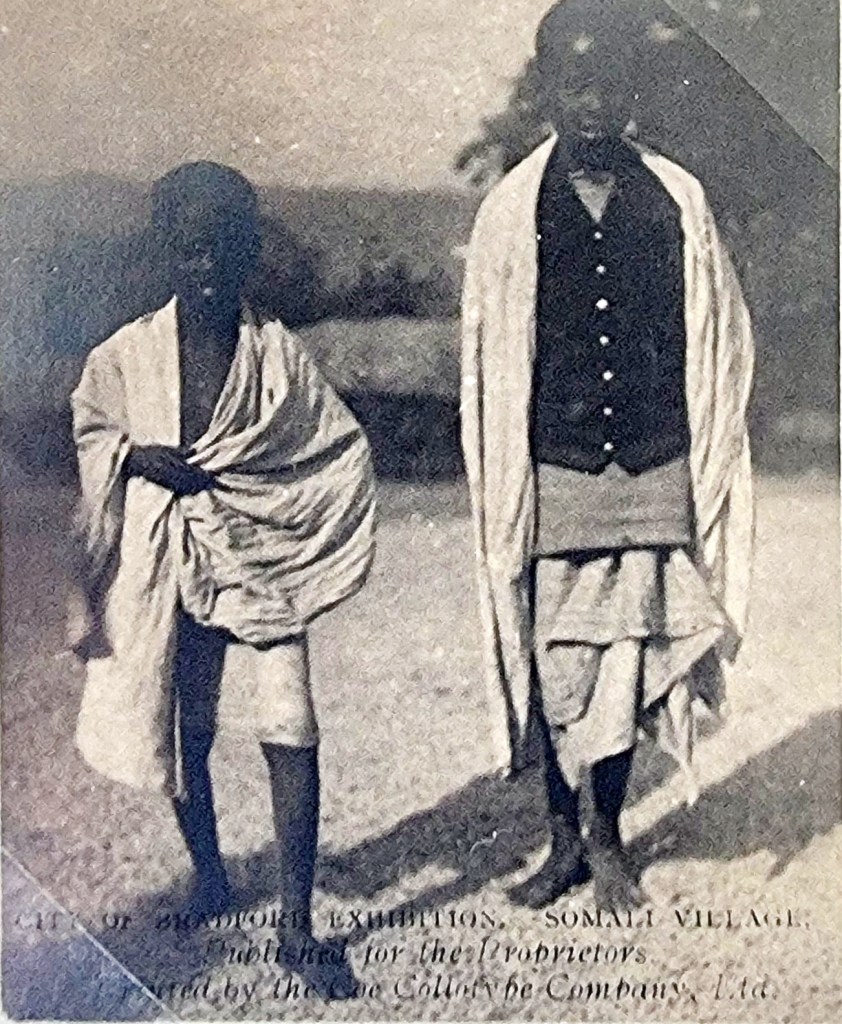
A rare group shot that also captures visitors inside the entrance to Bradford’s Somali Village. Courtesy of the Grahame Hall collection.
Yorkshire people were fascinated by Bradford’s Somali Village – it was the most popular attraction at the Great Exhibition of 1904, and this fascination landed the village in the local press numerous times. One particular article in the Bradford Weekly Telegraph caught my attention, titled “The Somali Sabbath – A Peculiar Form of Worship – A Sermon by The Mullah”, found under its “Our Churches and Chapels” section. This article is significant, as it has a specific focus on the Somalis’ worship as Muslims, and I was curious to see how the villager’s Islamic Identity was represented. A translator attached to the Village, Captain Charles Holland Hastings, was on hand to translate the Mullah’s Friday sermon for the Telegraph’s correspondent from the Arabic. For better understanding of the context, the original piece can be read here.[1]
Unsurprisingly, given that it was 1904, the article contains offensive material, which is written from a white colonial perspective and attitude, presumably by a white man.[2] However, I believe it essential to analyse the article carefully for three reasons: a) to understand what specific colonial frameworks shape the writing, b) to find out more about the Villagers’ lives; and c) to analyse how Somali villagers talk back to their white onlookers or express their agency in an article where the journalist didn’t interview one villager directly but relied on observation and a translator.
So how does the article structurally leave the Somalis at an othering distance from the white reader? What has an impact on the reader besides the writing itself? The piece describes for the reader what the Somali Villagers are like, what they do, and how they worship. But crucially, there are no interviews to further this purpose, despite there being a translator present. This follows a typical imperial practice where the coloniser spoke for the colonised, and their interpretations were not questioned. And so, as the writer describes the village, they make their readers complicit in the ethnographic framing: making the white onlooker the judging observer, who gets to decide what and who is ‘peculiar’ (a word used repetitively in this article with little or no explanation as to why it is being used as a descriptor). Language such as “The Somali is” or the repetition of “they” and “their” make the villagers sound like one homogenous group. The Somalis are never described as people, except through the Mullah’s words. The exhibition visitor, writer, and reader are all placed at just enough distance from the Somali villagers to be entertained by their discomfort and perceived superiority. Therefore, the villagers’ voices are purposely omitted to avoid interrupting this enjoyable distance. However, where the distance is not so comfortably maintained, the Somali Villagers’ agency, pride, and piety (taqwā in Arabic) can be found.
The writer is an unreliable narrator, often interpreting and exaggerating what the villagers do in a very negative way. In these moments where they condemn the villagers, I infer evidence about the villagers’ lives, and the pride and agency they had. Here, I discuss two examples.
As the product of an effort by the writer to convey the Mullah as a jealous and controlling man, we find a moment where the Mullah chooses his religion and his space over the white visitors. The journalist writes:
The Mullah has … a temporary stage … which he guards very jealously [my italics]. The other evening some visitor had the audacity to put his foot on this sacred erection, to the great annoyance … of his reverence….
The Mullah didn’t want shoes on his stage, as it is disrespectful in Islam to wear them in prayer spaces, as they are unsanitary. This shows the Mullah was unafraid to tell the visitors off to protect the purity of the prayer space. He limited their freedom to roam the village unimpeded after they paid to do so. The Mullah disrupts the distance between the visitor and the villager, as he demonstrates there are things he understands and the visitor does not, and that the visitor can cause offence. So they are not the civilised onlookers they believe themselves to be, and they are not in complete control. The journalist is uncomfortable that the Mullah would stand his ground, and thus seizes upon the most negative interpretation to explain why he would do so.[3]
Furthermore, the writer describes how, after the prayer, the Mullah preached to his fellow villagers. They describe it as “a wonderful address, interrupted many times by certain members of the congregation, who would insist on arguing and emphasising the various principles involved.” The free relationship between the Mullah and his fellow villagers is depicted unfavourably in the article, with the journalist writing that no one but the Mullah (including the Sultan) was allowed to touch the Quran, and ‘[the Mullah] then commanded the poor [my italics] Somalis’. The article insinuates that the villagers are being disrespectful and disobedient, but again, the journalist condemns what is unfamiliar to them and promptly contradicts themselves by alleging that the “poor” Villagers are controlled by the Mullah. I enjoy picturing the villagers arguing with him about what Islamic principles they think are the most important to discuss, which shows that religious debate and challenge of religious authority were part of the Villagers’ lives. At the same time, the Mullah is also able to control access to the Village’s copy of the Quran, even from the Sultan himself.
Furthermore, this free debate takes on a deeper meaning, given that the Mullah and the Villagers were well aware that a local journalist through the translator was going to write about their faith and religious practices, and were ensuring this was done simply and comprehensively. Already known to Somali adults and children, the basics of Islamic beliefs and teachings are instead presented for the benefit of educating the Yorkshire public to invite them to Islam by emphasising its similarities with Christianity. The white visitors are told that Mahomet (Muhammad) “occupies the same position as Jesus Christ, Moses, Abraham and other prophets”. The equivalence of the Prophet’s position helps the white people understand and validate Islam, but perhaps the Mullah telling them Jesus Christ is in the Quran would have been perceived as blasphemous to them. The Mullah goes on, with interjections from the Villagers, to outline fundamental ethics in Islam, an overview of the Prophet’s life and struggles in Mecca, and ending with the essential difference between Islam and Christianity that “Other people said there were other gods, but they were wrong, for the Koran taught that there was but one God.” Overall, it is fascinating how the Abrahamic religions collaborate and intersect here, in ways that could be advantageous to British people’s positive perception of the Somali villagers and their faith. It is right to infer this was a deliberate act of inviting Yorkshire people to Islam (da ‘wa in Arabic).
While the Somalis’ Islamic identity is so frequently othered in this article, it is also sometimes used as a point of relation to Christian Yorkshire through Islam being framed as an Abrahamic religion. The article is included in the “Our Churches and Chapels” section. The word “Our” tacitly includes the Somali Villager’s Islam, in contrast with the othering of the Somalis in the article. It is meaningful that the newspaper recognised Islam as a way other fellow human beings worship. There is a sharp contrast between treating the Somalis as almost another species to be studied and this language of inclusion. Christian terms are used to explain the practices of Islam to readers such as “The Somali Sabbath”, “Sermon”, or “priest” (used interchangeably with “Mullah”). This interchangeable use also leads to errors with the writer assuming Muslims have a day of rest on Wednesdays, when such a thing does not exist in Islam.
Freya Duncan is a 2nd year Liberal Arts Student at the University of Leeds with a major in Sociology, and is part of the student team on the research project “A Somali Village in Colonial Bradford”.
References
[1] Bradford Weekly Telegraph, 21 May 1904, p. 1. The original piece can be read here.
[2] However, as the journalist’s name isn’t attached to the article, I chose to use they/them to refer to them in the third person.
[3] This moment of protest seems to have been reported to the writer by someone else, probably another white visitor, so this negative interpretation has perhaps been passed down through different white onlookers and is affirmed by the journalist.
In Bradford in 1904, a group of Somali workers arrived to perform aspects of their culture to satisfy British curiosity about Somaliland, which they had recently invaded. A surprising number of these performers were children.
Somali children at the Bradford Exhibition of 1904, combining English and Somali dress to adapt to the colder weather. Courtesy of the Grahame Hall collection.
In this blog, I want to focus on the children who grew up in the Somali village in Bradford for two reasons. Firstly, examining this specific group of Somali children is valuable due to their unique circumstances as ethnographic performers. The psychological development of all children is critically shaped by their environment, which influences their perceptions and behaviours. At the same time, children are often more adaptable than adults, who have already formed solidified perceptions, allowing them to adjust quickly to new surroundings. So, the childhood experiences of these Somali children in Bradford are particularly noteworthy because they were exposed at a young age to the gaze of colonial powers through acting as representatives of Somali culture. These children had to navigate between distinct Somali and British cultures in the artificial environment of a staged “native” village. Another reason that I focus on these children arises from humanistic concerns. Colonialism likely caused more harm to children than adults, as these young individuals participated in tours due to the selfish interests of the colonisers and, in some sense, their elders. Unfortunately, as the historical record of the Village is almost entirely dominated by the Yorkshire archive, I can only present a general portrait of these children, portraying their work, studies, and family life, as observed through the eyes of their colonisers.
Several newspaper reports mention that during their six-month residence as part of the Bradford Exhibition, the Village’s children took responsibility for selling programme books rather than performing. They showed a willingness to use their talents to earn money. They used their linguistic skills to pick up some English quickly to make jokes for tips or kept a halfpenny for themselves when giving change. In a report by The Shipley Times and Express, it says,
The children especially are very pretty and plump, and they are very well-behaved, with the exception of their constant requests for “backsheesh,” which they playfully urge upon everyone. Many of them show an intelligent aptitude for learning English, and now and again, you can catch an English word in their conversations.[1]
Similarly, the Bradford Daily Argus notes,
One thing that all visitors to the village will notice about these Somali youngsters is their quick understanding of the value of English money. The sharp programme boy, for instance, is an impressive hawker. He is clever enough to try to gain a copper when giving change, but a visitor who attempts to negotiate with him regarding money will find it a challenging task. Another little boy approaches you in a business-like manner, asking for sixpence, having a handful of coppers in hand. He is really after a piece of silver, and if a visitor obliges, they may discover they receive only 5 1/2d in copper in exchange for their “tanner.”[2]
Adult Somali males, on the other hand, prided themselves on refusing handouts, viewing them as an insult.
The school at the Somali Village in Bradford, 1904, despite the misleading labelling of “Abyssinian Village” in German. Postcards of ethnographic shows were profitable, and were often relabelled and resold around Europe – Bradford was no exception to this, as this postcard shows. Courtesy of the Bodhari Warsame collection.
In addition to soliciting change from tourists, the children also attended school. The Somali performers established a school in the village specifically for the children, staffed by Somali teachers. They aimed to educate the children in their own culture and beliefs, where they were “taught to recite portions of the Koran and lessons from the Hafiz [Hadith].”[3] The results of this education are promising:
The copybooks of some of the children would do credit to any English school in terms of neatness and cleanliness. The writing is done in ink with a home-made pen, resembling a page of neatly written shorthand. The letters are Arabic, and the language is Somali. One scholar even wrote an essay about a chicken.[4]
Additionally, a clip showing the children demonstrating their learning ability reveals they were also taught elements of British culture:
To illustrate the children’s aptitude for knowledge, a young boy was introduced to an ARGUS representative, and with almost perfect pronunciation, he recited the first verse of the National Anthem. Although an attempt was made to teach the correct tune, he sang it in a style similar to a native chant.[5]
Unfortunately, this report also highlights the author’s colonial biases, as he disrespectfully refers to the child who sings the British national anthem as a “patriot” and expects him to sing it in the British manner rather with his traditional Somali technique.
Outside of school and work, the children bring their lively natures back to the traditional Somali family, which, while warm, can also be harsh. The author recalls witnessing a child chased by his father and judged by his clan for interrupting a ritual with his playfulness. The strict discipline of children within Somali culture is often questioned by the British, who fail to understand Somali parenting norms.[6]
A girl’s interaction with her mother illustrates the tender side of the Somali family:
When the food was ready, it was served in different dishes, some sugar sprinkled over it, along with a yellow liquid resembling egg yolk. The little girl ran and tasted from each bowl, and when her mother poured out a volley of reproaches, the girl unconcernedly took a handful of the mixture and skipped out of the woman’s reach. This little trick, performed with such playfulness, caused the mother to forget her anger and burst into laughter.[7]
As shown from these contemporaneous press reports, the children are portrayed relatively positively as showing remarkable adaptability and talent, along with their spirited nature, in contrast with the Somali adults who are largely depicted as solemn and tradition-bound. The children sought out tips from the audience and took risks, knowing they might be punished for their mischief. They studied Islamic texts in Arabic and sang the British national anthem in a spirited chorus. Despite their status as colonized individuals subjected to scrutiny, their clever and mischievous spirits are not completely suppressed in the colonial archive, allowing us to glimpse the Somali children carving out their own place in a difficult situation.
I have two reservations regarding this blog. Firstly, all the historical materials referenced are British accounts of the Somali villagers, which inevitably reflect the coloniser’s perspective on the colonised. This leaves me feeling uneasy about perpetuating a colonial viewpoint. Secondly, the available materials only relate to the children’s lives in the village, and I am equally concerned to find out what happened to them after leaving the Somali Village, as well as the longer-term impact this had on their lives. I hope to invite Somalis, especially the descendants of those who were part of the colonial experience, to share their memoirs and provide commentaries from a Somali perspective to address this gap in understanding.
Haiyi Xie is a 2nd year Liberal Arts Student at the University of Leeds, and is part of the student team on the research project “A Somali Village in Colonial Bradford”.
References
[1] Shipley Times and Express, 10 June 1904, p. 5.