Rowanne Smith
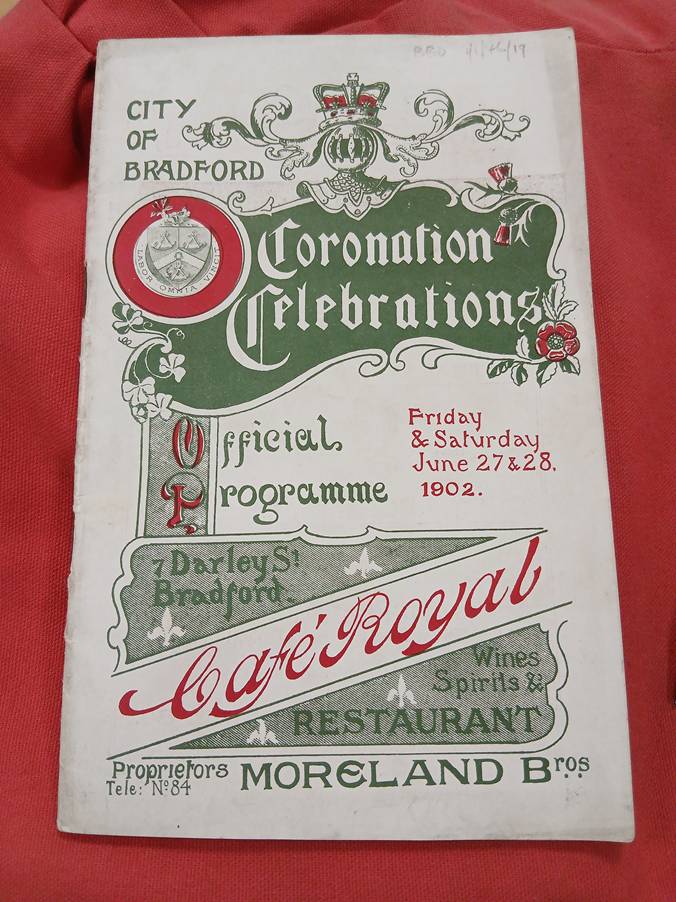
Mitchell and Kenyon’s film of the Bradford procession celebrating Edward VII’s coronation in June 1902 is now recognised as an important piece of cinema history (Bradford City of Film, 2008). It is described by the British Film Institute as:
A good starting point for any work on the British Empire and the place of the monarchy at the turn of the century… this roll succinctly summarises the place of Empire — within publicly staged versions, at least — in Britain’s sense of national identity. Two very different parts of the Empire, Canada and India, appear in the procession represented by ethnic stereotypes. (BFI Screenonline, 2004-13)
However, this brief description captures only a fragment of the colonial symbolism embedded in Bradford’s coronation celebrations. In the rest of this blogpost, I shall outline further how the procession highlighted various aspects of the city’s connections to the British Empire.
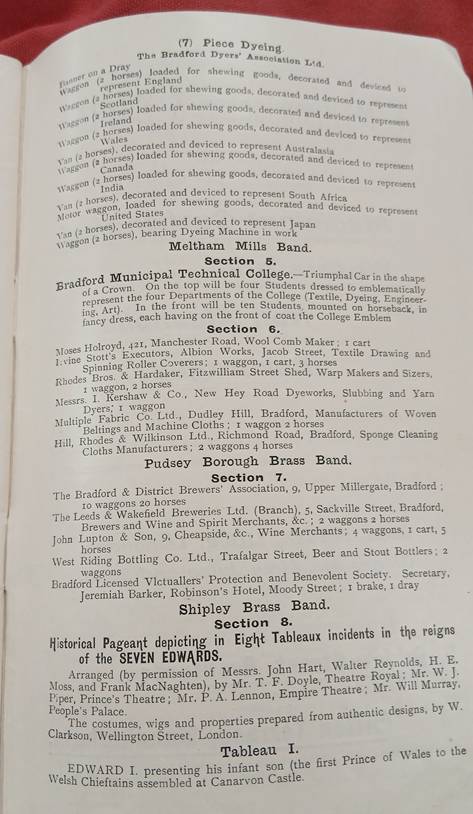
The procession itself did not just feature Canada and India; the same “section”, managed by the Bradford Dyers’ Association, also had waggons representing South Africa and Australia, described as “the four principal colonies” (City of Bradford, 1902a, p.17). Interestingly, Japan and the United States were also represented, with the United States further singled out by being represented by a motor car, while all the other floats were horse-drawn. The Bradford Dyers’ Association warrants further research, given its evident influence and international reach, operating internationally in Egypt, the United States, Canada (Greenhalf, 2012) and China (BFI, 2026), and were awarded a whole, stocked section in the procession. The floats may have celebrated the Association’s places of operation, while also gesturing towards desired trade relationships with the United States and Japan. Further information on their operations, influence and motivations could illuminate this organisation’s place in Bradford and international economic systems.
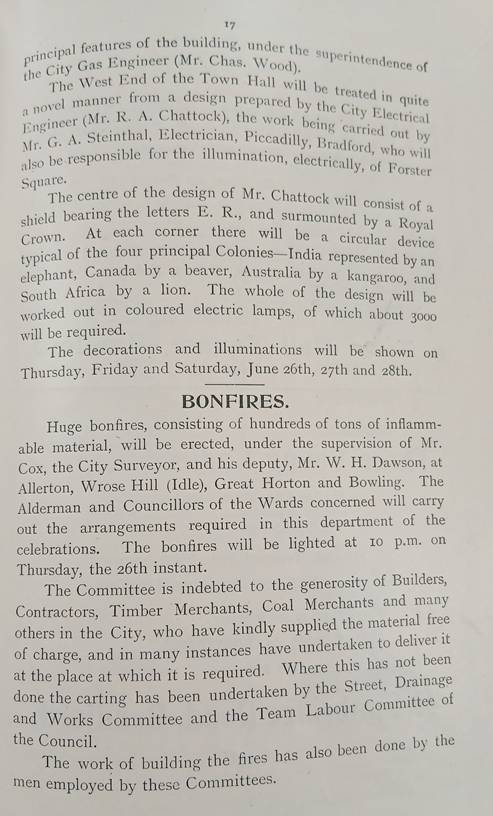
Throughout the coronation celebrations, particular emphasis was placed on the “principal colonies”: settler colonies with increasing administrative independence, later known as ‘dominions’ (Encyclopedia Britannica, 2026). Bradford’s illuminations included symbolic representations of each colony, with “India represented by an elephant, Canada by a beaver, Australia by a kangaroo, and South Africa by a lion”. Explicit references to colonial projects in India were also central to the celebrations. For example, after the Mayor’s “treat” to veterans, select veterans joined the procession. However, participation was highly selective: only medal-holders were accepted, most of whom were veterans of the Crimean War and the “Indian Mutiny”. Though calls had been made in the local press for veterans of the Boer War, insufficient responses led to their exclusion from the procession, although they were invited to the dinner (City of Bradford, 1902b). While several mayoral treats were held, the other guests were excluded from the procession, though schoolchildren were gathered for a performance of “God Save the King”. The structure of the procession suggests that the commemoration of colonial warfare, framed through civic pageantry, was a significant priority for the organisers.
Bradford’s coronation celebrations drew together official, military and commercial expressions of empire. The economic and ideological motivations and implications of these elements should be explored further through study of the Bradford Dyers’ Association. There is also limited publicly available information about the coronation celebrations of 1911, though these were likely to have been much smaller as the King did not visit Bradford.
Bibliography
Bradford City of Film. 2008. History and Heritage. [Online]. [Accessed 19th January 2026]. Available from: Layout 1
BFI. 2026. A Visit to Fuzhou with the Bradford Dyers Association and Shanghai Views. [Online]. [Accessed 10th February 2026]. Available from: Watch A Visit to Fuzhou with the Bradford Dyers Association and Shanghai Views online – BFI Player
BFI Screenonline. 2004-13. Essentially British?: Bradford Corporation Procession 1902. [Online]. [Accessed 19th January 2026]. Available from: BFI Screenonline: Essentially British?: Bradford Coronation Procession (1902)
Encyclopedia Britannica. [Online]. 2026. s.v. British Empire. [Accessed 18 February 2026]. Available from: https://www.britannica.com/place/British-Empire
City of Bradford. 1902a. City of Bradford Coronation Celebration Official Programme.
City of Bradford. 1902b. City of Bradford Coronation. Procession, Sub Committee Minute Book
Greenhalf, J. 2012. Prestige and power of a material world. Telegraph and Argus. [Online]. 28th November. [Accessed 10th February 2026]. Available from: Prestige and power of a material world | Bradford Telegraph and Argus
With thanks to the West Yorkshire Archive Service for permission to republish images of the coronation booklet.
Rowanne Smith studies Liberal Arts at the University of Leeds, majoring in Philosophy. Born and raised in West Yorkshire, the story of the Somali Village is close to home for her.


Leave a Reply