Rowanne Smith
As the world’s first UNESCO City of Film, Bradford has a significant heritage as a centre of film production (Bradford City of Film, 2008). Cinema’s role in shaping public perception is well established. As the pervasive racism of early Hollywood receives greater attention, scholars have also increasingly examined the racist and colonial tones of early British and European cinema (see Deroo and Fournié, 2011). Bradford’s 2008 bid for recognition as a City of Film openly acknowledged cinema’s colonial links. It noted, for example, the government-run Imperial Film Company’s operation from Bradford Town Centre Offices, local screenings of its films, and the ways films of Bradford captured twentieth-century colonial symbolism, for example, Mitchell and Kendall’s famous recording of the 1902 Coronation Procession, featuring wagons representing India and Canada (Bradford City of Film, 2008; Smith, 2026a). It also acknowledged the legacy of the less well-known media that helped shape early cinema’s colonial content, the “magic lantern slides”, which were also an influential medium in their own right (De Weerdt, 2023).
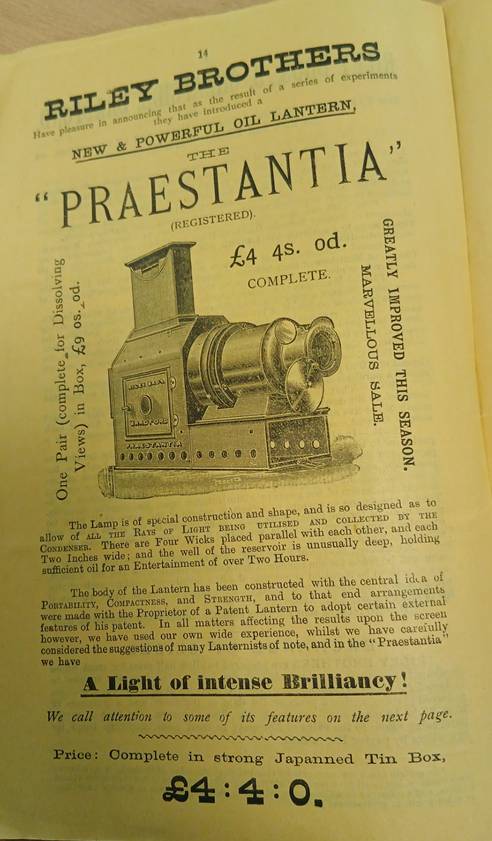
Developed in the seventeenth century, magic lanterns were projectors that enabled small glass slides to be shown to a large audience (De Weerdt, 2023). Originally used for religious instruction, they later became a versatile and diverse medium, used as stand-alone entertainments and to illustrate lectures in a variety of settings, from churches and schoolrooms to music halls and fairgrounds, often blurring the boundaries between entertainment and education in both the presenter’s intent and the audience’s reception (De Weerdt, 2023; MacKenzie, 1984). This diversity made magic lantern slides easy to adapt to a variety of colonial purposes: dioramas of colonised places promoted emigration; images of “primitive” peoples illustrated missionary appeals and meetings; and entertainments could draw on racist humour and colonial adventure narratives, all of which created a blueprint for the presentation of colonialism in later cinema (MacKenzie, 1984).
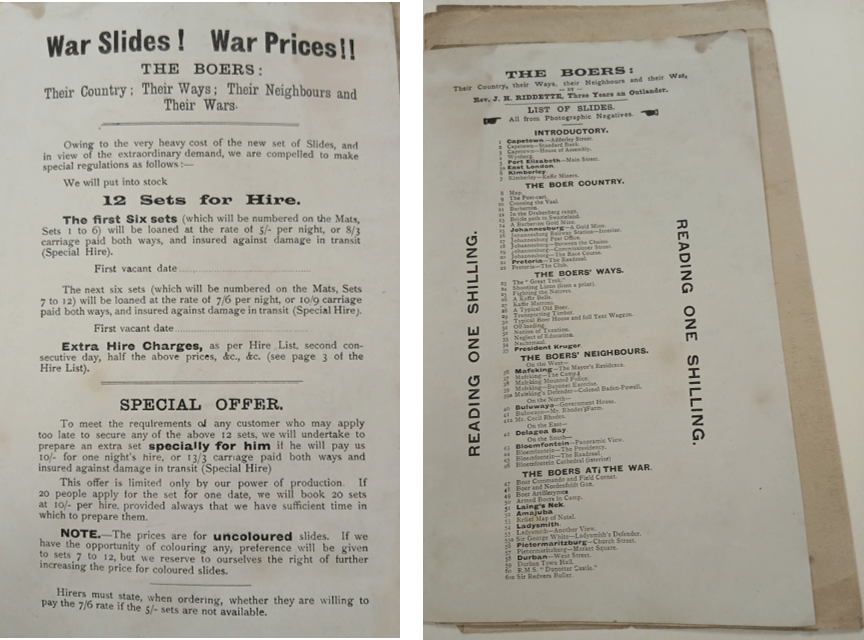
Bradford not only hosted such magic lantern shows, but was a centre for their production and distribution. Bradford was home to the Riley Brothers, a successful magic lantern company which rented slide sets, magic lanterns, and accessories to the public, claiming to have the world’s largest collection of slide sets (Bradford City of Film, 2008). Keen to meet public demand for information and entertainment related to colonial warfare, the company commissioned new slide sets on South Africa and the Boer Wars in 1899 (Riley Brothers, 1899). Bradfordians’ continued interest in the Boer Wars and South Africa can be seen in later, more public spectacles, such as the Savage South Africa Show in 1901, the Coronation celebrations in 1902, and the Buffalo Bill show in 1903 (Smith, 2026a, 2026b).
Although magic lanterns clearly shaped popular understandings of colonialism and contributed to the development of cinema, their distinctive role in religious and educational contexts also deserves emphasis. The Riley Brothers’ business demonstrates magic lanterns’ continued association with religion and education. Missionaries were among their target customers. Their catalogue marks slide sets as suitable for missionary meetings with an “M”, and they created a cheap loan system to encourage more rentals from religious organisations (Riley Brothers, 1890). Ellie Boyce (2026) has written on the importance of missionary work in Bradford’s links to colonialism, demonstrating the significance of magic lantern slides to Bradford’s colonial links beyond their relationship on cinema. The Riley Brothers also catered to educational institutions, offering to support teachers in finding lecturers to deliver their slides, and had educational sets explaining the colonial provenance of tea (Riley Brothers, 1890). MacKenzie (1984) argues that education about everyday objects was seen as a way to encourage children to recognise the Empire’s importance in their daily lives. The Riley Brothers’ emphasis on missionary work and education demonstrates the significance of the magic lantern in diffusing imperial doctrines beyond its contribution to cinema.
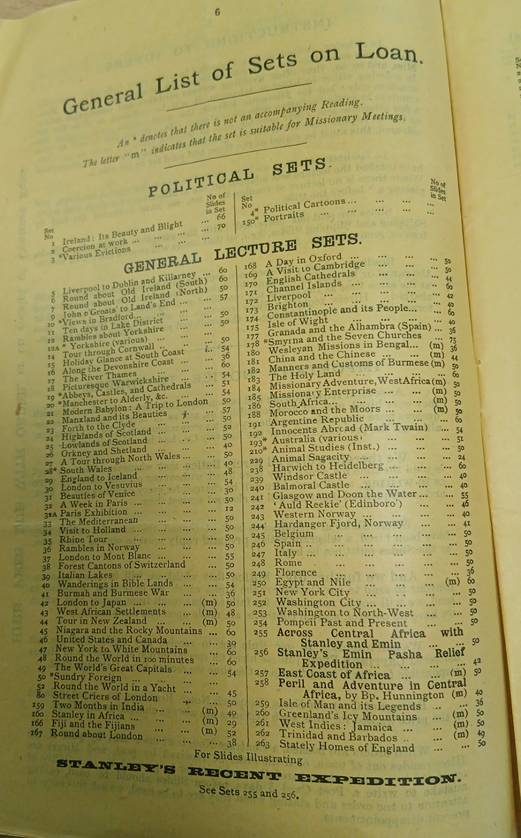
Magic lantern slides helped to reinforce different colonial projects in Bradford and further afield, rallying (already enthusiastic) support for the Boer Wars and supporting colonial missionary work and children’s education on the British Empire. This distinct contribution should be considered alongside magic lanterns’ role in the development of cinema, and the wider connection between visual culture and empire that Bradford has rightly acknowledged (De Weerdt, 2023, Bradford City of Film, 2008).
Bibliography
Boyce, E. 2026. “Yorkshire’s Role in Overseas Christian Missions.” Somali Village. [Online.] Available at: https://somalivillage.org.uk/2026/07/28/yorkshires-role-in-overseas-christian-missions/ [Accessed 28 July 2026].
Bradford City of Film. 2008. History and Heritage. [Online]. [Accessed 19th January 2026]. Available from: Layout 1
De Weerdt, A. 2023. Exotism and politics on the big screen: Colonial magic lantern shows in Belgium. 23 February. Arts and Media Archaeology. [Online]. [Accessed 10th February 2026]. Available from: Exotism and politics on the big screen: Colonial magic lantern shows in Belgium – Arts Media Archaeology
Deroo, É. and Fournié, P. 2011. ‘From postcard to cinematograph: inventing reality’, in Blanchard, P. et al (eds.) Human zoos: science and spectacle in the age of colonial empires. Liverpool: Liverpool University Press, pp. 287–296.
MacKenzie, J.M. 1984. Propaganda and Empire: The Manipulation of British Public Opinion, 1880-1960. Manchester University Press.
Riley Brothers. 1890. Season 1890-91 Hire List. Magic Lanterns and Lantern Slides From Riley Brothers.
Riley Brothers. 1899. War Slides! From Riley Bros. Ltd. Bradford. [Advert].
Smith, R. 2026a. Bradford’s Colonial Spectacles: Private Entertainment and Imperial Propaganda. Somali Village. [Online.] Available at: https://somalivillage.org.uk/2026/07/27/bradfords-colonial-spectacles-private-entertainment-and-imperial-propaganda/ [Accessed 28 July 2026].
Smith, R. (2026b). Bradford’s 1902 Coronation Celebrations. Somali Village. [Online.] Available at: https://somalivillage.org.uk/2026/07/27/bradfords-1902-coronation-celebrations/ [Accessed 28 July 2026].
With thanks to the West Yorkshire Archive Service, Bradford, for permission to republish these images.
Rowanne Smith studies Liberal Arts at the University of Leeds, majoring in Philosophy. Born and raised in West Yorkshire, the story of the Somali Village is close to home for her.

