Orlagh McSorley
In its first month of opening, the Yorkshire Factory Times carried a review of Bradford’s Great Exhibition of 1904, which focused upon how competently it sold the city as a global leader in industrial innovation, especially in its largest industry of textile production. As an aside, the review provided a throwaway comment on the presence of a handloom in the Somali Village, the most popular entertainment at the Exhibition:In its first month of opening, the Yorkshire Factory Times carried a review of Bradford’s Great Exhibition of 1904, which focused upon how competently it sold the city as a global leader in industrial innovation, especially in its largest industry of textile production. As an aside, the review provided a throwaway comment on the presence of a handloom in the Somali Village, the most popular entertainment at the Exhibition:
The hand loom in the exhibition weaving cloth goods is a novelty, but is that and nothing more, as is also the spinning wheel, with its combed wool spun into weft. The loom in the Somali portion, if a correct method of weaving as carried on in the black districts, won’t cause foreign competition to teach us to put tariffs on.[1]
Contemporaneous Somali hand-weaving was dismissed as part of the old world that Britain had left through industrial innovation, as a quaint novelty that had no relevance to the hard-nosed world of technology and business. In the rest of this blog, I shall set out to challenge this casual and racializing dismissal.
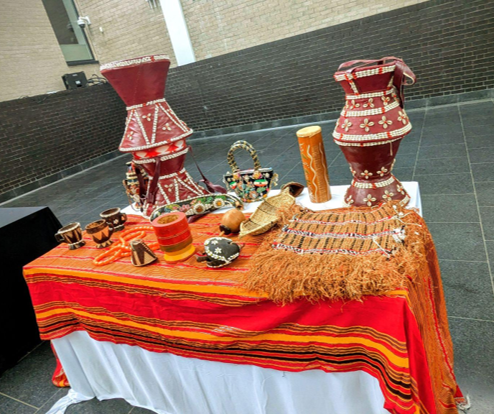
The practice of Somali hand-weaving brings together music, art, practicality and heritage. Precisely because of this hybridity, I argue, it also posed a threat to the British Empire’s attempt to present African cultural production as static, primitive or inferior. By examining the historical treatment of hand-weaving, while also challenging its current perception as an archaic folk art, we can better understand the relationship between Somalia’s colonisation and the cultural practices that are now at risk of being lost to members of the diaspora. In this context, the juxtaposition between hand-weaving in the 1904 Somali Village and the textile machines displayed in the Industrial Hall becomes symbolic of the unequal relationship between Britain and its imperial subjects.
To begin with, the historical significance of weaving in Somalia has been largely ignored in academic research. This neglect helps obscure the impact that the decline of Somali textile exportation had on the country’s economic and cultural identity. As Clarence-Smith states,
the Benadir coast of Somalia had an ancient reputation as an exporter of cotton textiles. Back in the fourteenth century, Ibn Battuta noted that the “unequalled” cloth of Mogadishu was exported “to Egypt and elsewhere.”[2]
This history shows that Somalia’s role in textile production has been systematically disregarded. Such disregard reflects a wider colonial framework in which African products are valued only when they can be extracted, appropriated or reinterpreted through European systems of knowledge and production. Britain benefited from processes perfected over centuries in Somalia while also contributing to the removal of resources and labour that could have supported Somalia’s own technological development. As factory methods came to dominate global textile production, hand-weaving was increasingly pushed aside and associated with a supposedly pre-modern past. In this way, the 1904 exhibition, which featured the Somali Village in juxtaposition to the Industrial Hall, helped justify British imperialism to white audiences through the display of technological advancement.
This contrast was especially visible in the relationship between the Somali Village and the wider 1904 Bradford Exhibition. Hattersley’s, based in Keighley, invented, patented and manufactured the “self-shuttling” loom in 1901, before its introduction into the Industrial Hall at the 1904 Bradford Exhibition.[3] By placing Somali hand-weaving in the Village alongside such industrial advances, the exhibition encouraged visitors to read Somali labour as slow, manual and inferior. Yet this framing ignores the historical and cultural importance of hand-weaving, as well as the performers’ own skill and labour. They built the village by hand and sustained a community in a completely new environment in Bradford for six months. The contrast between the Somali Village and the Bradford Exhibition was therefore not neutral: it shaped, and was shaped by, Britain’s colonial view of Africa and its people.
A further dimension of this erasure is the role of women in hand-weaving. The hand-weaving exhibited in the Somali Village would likely have been undervalued and treated as folk art to be viewed with patronising wonder. This dismissal was intensified by the fact that, in Somalia, most hand-weaving is traditionally done by women. When positioned against the industrial, scientific and technological – and therefore, by extension, male – achievements displayed in the 1904 Exhibition, Somali hand-weaving could be reduced to a women’s pastime rather than recognised as skilled cultural production:
In a jointly sponsored UNESCO and UNICEF report on a seminar held in April 1978 in Mogadishu on Basic Education for Nomads, “[..] Arts and Crafts among the Somali nomads centre on wood carving; camel bells, wooden spoons, forks, dishes, walking sticks etc.” It is interesting that the arts and crafts of which the author Abdi Arte speaks are woodcarving, the one and only craft executed by men.[4]
The failure to recognise objects made by women therefore reproduces two forms of hierarchy at once. It privileges Western technology over Somali craft, and it privileges male-made objects within Somali cultural history over the work of women. As a result, the strength, knowledge and skill of women weavers are pushed out of view, allowing hand-weaving to be framed as a historical craft left behind by Western progress rather than as a living and complex cultural practice in its own right.
At the same time, hand-weaving in the Somali Village may also have helped connect the performers to the homes they had left behind. However, this cultural connection was complicated by the commercial setting of the exhibition, where the troupe sold their handmade items to visitors. This created a tension between hand-weaving as a practical and cultural practice and hand-weaving as a performance for a white audience looking on from a position of power. Demonstrating a cultural activity for the coloniser intensified the white gaze and turned Somali labour into entertainment for the crowd. As bell hooks argues,
Often in contemporary capitalist society, where “folk art” is an expensive commodity in the marketplace, many art historians, curators, and collectors still assume that the folk who created this work did not fully understand and appreciate its “aesthetic value”.[5]
This is significant because hand-weaving was not simply a visual or material practice. Songs would have been sung while weaving in the aqal, a nomadic home traditional to the Somali people. These intertextual qualities show that hand-weaving brought together sound, movement, labour and memory. They also highlight the cultural richness of a practice that has been almost lost for many living members of the diaspora.
To conclude, restoring hand-weaving both as a practical technological process and a form of cultural history cannot undo Britain’s role in helping to erode this traditional Somali practice. However, it can offer a starting point for recovering its significance. Current projects that centre Somali voices and diasporic experiences are now exploring how this history can be expressed through the multifaceted process of hand-weaving. For the Somali people in Bradford’s staged village, hand-weaving may have been an essential expression of culture: a way of sustaining material, spiritual and communal connections while living for six months in a hostile environment. Fozia Ismai’s projects have been invaluable in developing artistic approaches to the historical significance of hand-weaving:
Our latest project Audible Tapestries has allowed us to research Somali nomadic weaving techniques and tactile technologies that can be incorporated into. Conventionally, all weaving is done by women in Somali nomadic life, from the creation of the Aqal (a portable house) to almost all of the household objects within it.[…][6]
The Somali Village charity also contributes to this process of recovery by preserving and curating evidence of hand-weaving. Its exhibition at Cartwright Hall aims “to commemorate the history and heritage of the Somali diaspora in the physical landscape.”[7] Together, these projects suggest that hand-weaving should not be understood as a relic of the past, but as a continuing practice through which Somali history, gendered labour and diasporic memory can be made visible again.
Orlagh McSorley produced this blog post as an output of her module FOAH2002 Student Research Partnerships, part of the BA in Liberal Arts at the University of Leeds, during a placement with the Somali Village in Colonial Bradford project in the academic year 2025–26.
Endnotes
[1] Yorkshire Factory Times, 27 May 1904, p.1
[2] William Gervase Clarence-Smith, ‘Locally produced textiles on the Indian Ocean periphery 1500‒1850: East Africa, the Middle East, and Southeast Asia’, Global Economic History Network, (2006), p. 20.
[3] Eugene Joseph Nykolyszyn, ‘Innovation, diffusion and technology change. A study of the Yorkshire worsted industry (1890-1939)’, PhD thesis, University of Leeds, (2022), p. 93.
[4] Arlene Fullerton and Amina Ada, Handicrafts of the Nomadic Women of Somalia. (Smithsonian Libraries African Art Index Project, 1995), p. 2.
[5] bell hooks, Yearning: Race, Gender and Cultural Politics. (Boston: South End Press, 1990).
[6] Fozia Ismai, Weaving with fragments and fractures <https://archive-stories.com/Weaving-with-fragments-and-fractures> [Accessed 26 February 2026].
[7] A Somali Village in Colonial Bradford <https://somalivillage.org.uk/about/> [Accessed 1 March 2026].

