Tag: British history

  • The Somalis as Early Migrant Workers in Bradford’s Labour History

    Maxie Allen

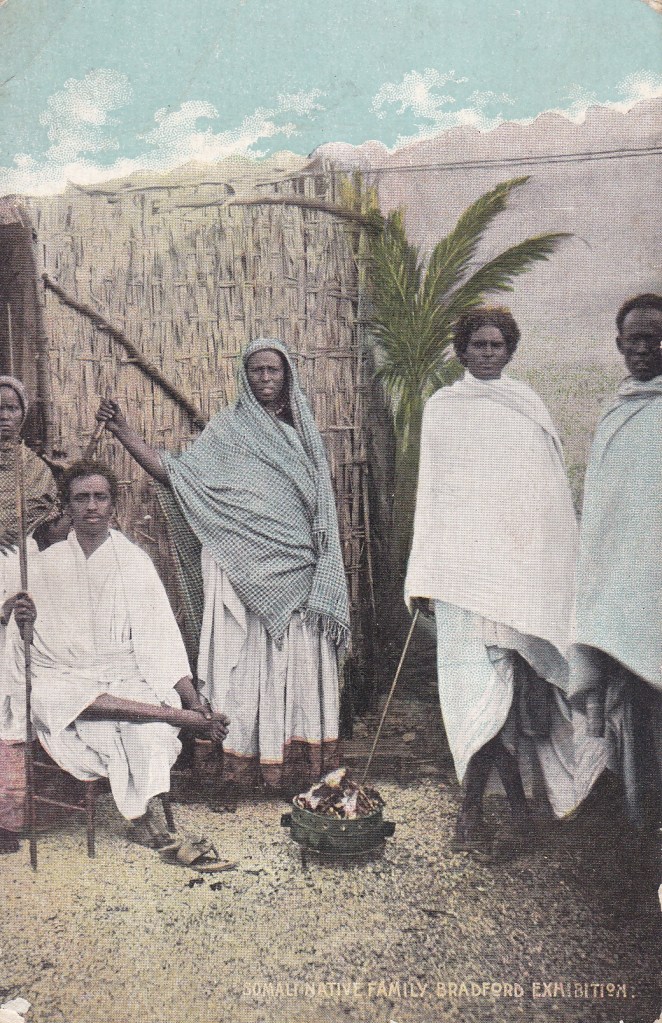
    Staged here as a native Somali family in the Bradford Exhibition, they were also transnational workers in a system of imperial labour relations. Courtesy of the Yahya Birt collection.

    The story of the Somali workers’ trip to Yorkshire reaches far back into the colonial history of Europe and Africa, and all the way forward into the lives of migrants in Bradford today. In trying to weave this story, I’ve found myself pulled down snickets, sidetracked into obscure ginnels of history.  The traces left behind by the 57 Somali workers demonstrate a certain proud agency in surviving exploitative employment.

    I must start this story of migration somewhere, and I’d rather start it with Hersi Egeh Gorseh than yet another white male coloniser. Gorseh was a Somali tribal chief who, in collaboration with German businessmen, recruited Somali performers for an 1895 ethnographic show in Hamburg. He was paid well for this work, and became lifelong friends with some of his European colleagues. He recruited performers from his inner circle, and for years this troupe travelled around Europe, honing their skills. Bodhari Wasame, a Somali researcher within this project, suggests many reasons for individuals to have undertaken these journeys; to earn more than at home, to see the world, to represent Somali heritage and warriorship.[1]  Hersi Gorseh, in pioneering these tours, ended up with the name “Hersi Arwo” – a Somali word meaning “exhibition”, which in turn gave its name to the distinct profession of the Arwo, spelt “Carwo” in Somali, or “the people of the fair”.

    This said, I do not want to downplay the colonialism that landed the Somali troupe in Bradford – the popular phrase “we’re here because you were over there” was as true in 1895 as it is today. Europeans were fascinated by the so-called “colonies”, an interest that sparked this recruitment for wildly successful ethnographic shows, including Bradford’s 1904 Exhibition. This speaks to the experience of so many migrants. The West promises travel and work, while exploiting the labour of those whose homelands have already been exploited. 18.7% of Bradford’s population today is non-UK born,[2] and many of these same complex motivations may have drawn them to the city, both the allure of a better life and the neo-colonialism that exploits migrant workers.

    Once the troupe made it to Bradford, they joined the enormous workforce running the Great Exhibition at Lister Park. As the compound they lived in was open to the public, everyday tasks like washing and cooking were as much a part of the show as the spear throwing demonstrations the villagers performed. The voices of the troupe are missing from the archive, but it is easy to imagine how, as Bodhari Wasame suggests, ‘the Somalis cleverly exploited […] their ethnic differences’,[3] giving white onlookers the exotic experience they were looking for. This performative Africanness earned them various rates of pay, starting at £7‒12 for the six months’ work, all the way up the troupe leader’s, £42. Although still earning a low wage, male mill workers at this time outearned the Somalis, making about £20 in 6 months. Female mill workers would earn half a man’s wage, like the rates of pay in the Somali village.[4] While there is no record of gendered pay grades within the archive, I do wonder if gender and race intersected in the lives of Arwo women to create a unique financial handicap, as is the experience of many migrant women today.

    There were opportunities for supplementary income within the compound, with photo opportunities and traditional handicrafts sold to visitors. This level of entrepreneurship points us to two aspects of the villagers’ lives – the inadequacy of their wages and the business acumen they possessed.

    The full extent of the troupe’s proud agency was expressed on 31 October 1904. After a fire destroyed four of the huts in the compound, two of which contained valuables, the  villagers took to the steps of the town hall to demand compensation. This protest places the troupe firmly in Bradford’s long history of workers agitating for their rights. Just 14 years earlier, the Manningham Mills strike had taken their struggle for fair wages to the same spot, also marching into the town centre from the Manningham area, the site of Lister Park where the Somali Village was. At pickets in Docker’s Square, crowds of 90,000 gathered to hear union leaders speak.[5] The strike, although unsuccessful, would change British politics forever. The formation of the Bradford Labour Union came a month after the strike failed, and by 1893 had formed the Independent Labour Party. The working classes of Bradford had realised that both Liberal and Conservative political leaders could not advocate for the interests of workers.

    The mill owner at the heart of the Manningham Mills strike was none other than Samuel Lister, who had gifted Lister Park to the city only 20 years earlier. Following the scandal of the strike, the city needed to preserve its reputation and industrial relevance and decided to stage the Great Exhibition. It is easy to imagine that Samuel was equally eager to save face and attach the family name to a win for the city. And so, in 1904, the Somali troupe arrived in Manningham, but didn’t leave without causing another scandal. Without access to the thoughts and feelings of those 57 people,  we are left to speculate about whether they were aware of the area’s political history. To fantasise about worker solidarity here may be naïve given the racism the troupe suffered, but perhaps local people advised them to picket the town hall. Either way, the proud dignity of the Somali workers has ensured their story can be read as part of the worker’s resistance to exploitation that shaped the labour movement in Yorkshire.

    Their legacy echoes down to the lives of those who adopt Bradford as their home now, and find themselves in precarious, poorly paid work compared with their British peers. I hope that all workers, migrant or otherwise, find encouragement in the bravery of Bradford’s Somali visitors, and advocate for their own rights accordingly.

    Maxie Allen is involved in various food justice projects in the city of Leeds, where she is also studying for a Liberal Arts degree at the University. She is passionate about Yorkshire, both its folk and political history and the grassroots organising of present-day communities.

    References

    [1] Bodhari Wasame, ‘A Brief History of Staging Somali Ethnographic Performing Troupes in Europe.1885-1930’, in Staged Otherness: Ethnic Shows in Central and Eastern Europe, 1850‒1939, edited by Dagnoslaw Demski and Dominika Czarnecka (Prague: Central European University Press, 2022), pp. 77–100 (p. 79).

    [2] “12 Migration Related Insights from the Census 2021 for Yorkshire and Humber”, Migration Yorkshire, 2022, https://www.migrationyorkshire.org.uk/12-migration-related-insights-census-2021-yorkshire-and-humber, accessed 28 March 2025.

    [3] Warsame, “A Brief History”, p. 89.

    [4] George Henry Wood, “The Statistics of Wages in the United Kingdom during the Nineteenth Century. (Part XV.) The Cotton Industry”, Journal of the Royal Statistical Society, 73/2 (1910), pp. 39‒48 (p. 42).

    [5] Keith Narey, “The Great Manningham Mills Strike, 1890”, Marxists.orghttps://www.marxists.org/history/etol/writers/narey/1978/08/mannmills.html, accessed 31 March 2025.

  • The Representation of the Somali Villagers’ Islamic Identity in the Bradford Weekly Telegraph

    Freya Duncan

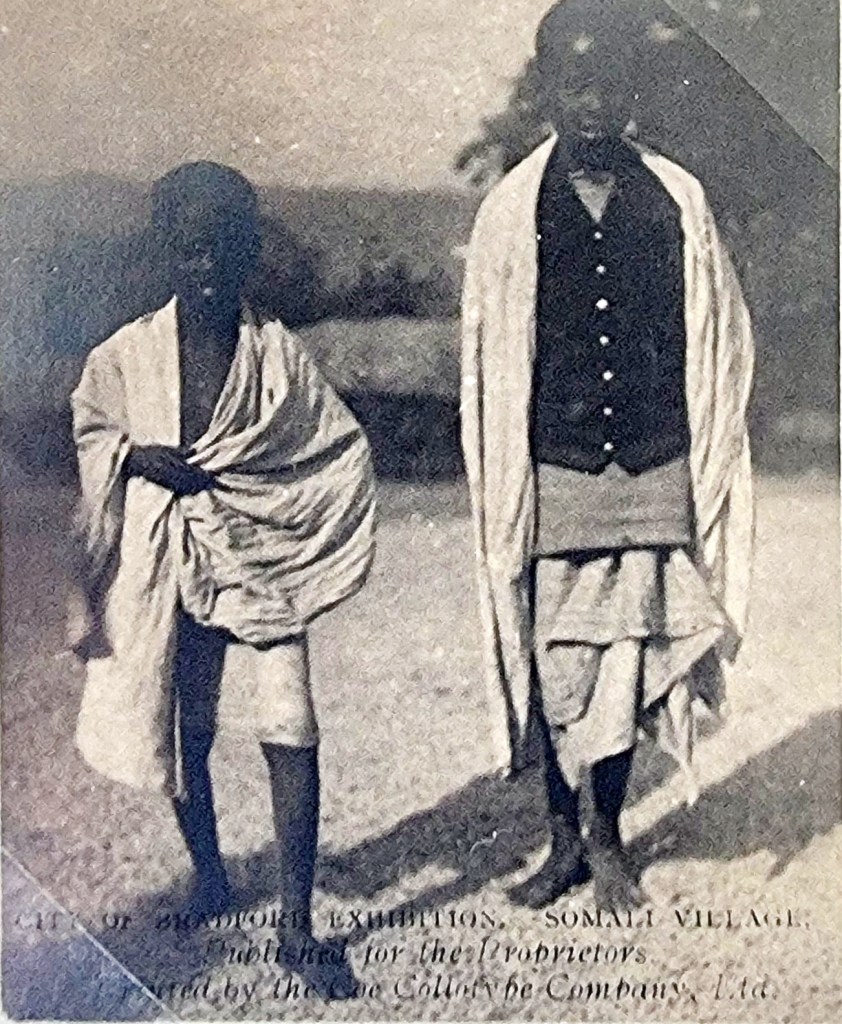
    A rare group shot that also captures visitors inside the entrance to Bradford’s Somali Village. Courtesy of the Grahame Hall collection.

    Yorkshire people were fascinated by Bradford’s Somali Village – it was the most popular attraction at the Great Exhibition of 1904, and this fascination landed the village in the local press numerous times. One particular article in the Bradford Weekly Telegraph caught my attention, titled “The Somali Sabbath – A Peculiar Form of Worship –  A Sermon by The Mullah”, found under its “Our Churches and Chapels” section. This article is significant, as it has a specific focus on the Somalis’ worship as Muslims, and I was curious to see how the villager’s Islamic Identity was represented. A translator attached to the Village, Captain Charles Holland Hastings, was on hand to translate the Mullah’s Friday sermon for the Telegraph’s correspondent from the Arabic. For better understanding of the context, the original piece can be read here.[1]

    Unsurprisingly, given that it was 1904, the article contains offensive material, which is written from a white colonial perspective and attitude, presumably by a white man.[2] However, I believe it essential to analyse the article carefully for three reasons: a) to understand what specific colonial frameworks shape the writing, b) to find out more about the Villagers’ lives; and c) to analyse how Somali villagers talk back to their white onlookers or express their agency in an article where the journalist didn’t interview one villager directly but relied on observation and a translator.

    So how does the article structurally leave the Somalis at an othering distance from the white reader? What has an impact on the reader besides the writing itself? The piece describes for the reader what the Somali Villagers are like, what they do, and how they worship. But crucially, there are no interviews to further this purpose, despite there being a translator present. This follows a typical imperial practice where the coloniser spoke for the colonised, and their interpretations were not questioned. And so, as the writer describes the village, they make their readers complicit in the ethnographic framing: making the white onlooker the judging observer, who gets to decide what and who is ‘peculiar’ (a word used repetitively in this article with little or no explanation as to why it is being used as a descriptor). Language such as “The Somali is” or the repetition of “they” and “their” make the villagers sound like one homogenous group. The Somalis are never described as people, except through the Mullah’s words. The exhibition visitor, writer, and reader are all placed at just enough distance from the Somali villagers to be entertained by their discomfort and perceived superiority. Therefore, the villagers’ voices are purposely omitted to avoid interrupting this enjoyable distance. However, where the distance is not so comfortably maintained, the Somali Villagers’ agency, pride, and piety (taqwā in Arabic) can be found. 

    The writer is an unreliable narrator, often interpreting and exaggerating what the villagers do in a very negative way. In these moments where they condemn the villagers, I infer evidence about the villagers’ lives, and the pride and agency they had. Here, I discuss two examples. 

    As the product of an effort by the writer to convey the Mullah as a jealous and controlling man, we find a moment where the Mullah chooses his religion and his space over the white visitors. The journalist writes:

    The Mullah has … a temporary stage … which he guards very jealously [my italics]. The other evening some visitor had the audacity to put his foot on this sacred erection, to the great annoyance … of his reverence….

    The Mullah didn’t want shoes on his stage, as it is disrespectful in Islam to wear them in prayer spaces, as they are unsanitary. This shows the Mullah was unafraid to tell the visitors off to protect the purity of the prayer space. He limited their freedom to roam the village unimpeded after they paid to do so. The Mullah disrupts the distance between the visitor and the villager, as he demonstrates there are things he understands and the visitor does not, and that the visitor can cause offence. So they are not the civilised onlookers they believe themselves to be, and they are not in complete control. The journalist is uncomfortable that the Mullah would stand his ground, and thus seizes upon the most negative interpretation to explain why he would do so.[3]

    Furthermore, the writer describes how, after the prayer, the Mullah preached to his fellow villagers. They describe it as “a wonderful address, interrupted many times by certain members of the congregation, who would insist on arguing and emphasising the various principles involved.” The free relationship between the Mullah and his fellow villagers is depicted unfavourably in the article, with the journalist writing that no one but the Mullah (including the Sultan) was allowed to touch the Quran, and ‘[the Mullah] then commanded the poor [my italics] Somalis’. The article insinuates that the villagers are being disrespectful and disobedient, but again, the journalist condemns what is unfamiliar to them and promptly contradicts themselves by alleging that the “poor” Villagers are controlled by the Mullah. I enjoy picturing the villagers arguing with him about what Islamic principles they think are the most important to discuss, which shows that religious debate and challenge of religious authority were part of the Villagers’ lives. At the same time, the Mullah is also able to control access to the Village’s copy of the Quran, even from the Sultan himself.

    Furthermore, this free debate takes on a deeper meaning, given that the Mullah and the Villagers were well aware that a local journalist through the translator was going to write about their faith and religious practices, and were ensuring this was done simply and comprehensively. Already known to Somali adults and children, the basics of Islamic beliefs and teachings are instead presented for the benefit of educating the Yorkshire public to invite them to Islam by emphasising its similarities with Christianity.  The white visitors are told that Mahomet (Muhammad) “occupies the same position as Jesus Christ, Moses, Abraham and other prophets”. The equivalence of the Prophet’s position helps the white people understand and validate Islam, but perhaps the Mullah telling them Jesus Christ is in the Quran would have been perceived as blasphemous to them. The Mullah goes on, with interjections from the Villagers, to outline fundamental ethics in Islam, an overview of the Prophet’s life and struggles in Mecca, and ending with the essential difference between Islam and Christianity that “Other people said there were other gods, but they were wrong, for the Koran taught that there was but one God.” Overall, it is fascinating how the Abrahamic religions collaborate and intersect here, in ways that could be advantageous to British people’s positive perception of the Somali villagers and their faith. It is right to infer this was a deliberate act of inviting Yorkshire people to Islam (da ‘wa in Arabic).

    While the Somalis’ Islamic identity is so frequently othered in this article, it is also sometimes used as a point of relation to Christian Yorkshire through Islam being framed as an Abrahamic religion. The article is included in the “Our Churches and Chapels” section. The word “Our” tacitly includes the Somali Villager’s Islam, in contrast with the othering of the Somalis in the article. It is meaningful that the newspaper recognised Islam as a way other fellow human beings worship. There is a sharp contrast between treating the Somalis as almost another species to be studied and this language of inclusion. Christian terms are used to explain the practices of Islam to readers such as “The Somali Sabbath”, “Sermon”, or “priest” (used interchangeably with “Mullah”). This interchangeable use also leads to errors with the writer assuming Muslims have a day of rest on Wednesdays, when such a thing does not exist in Islam. 

    Freya Duncan is a 2nd year Liberal Arts Student at the University of Leeds with a major in Sociology, and is part of the student team on the research project “A Somali Village in Colonial Bradford”.

    References

    [1] Bradford Weekly Telegraph, 21 May 1904, p. 1. The original piece can be read here.

    [2] However, as the journalist’s name isn’t attached to the article, I chose to use they/them to refer to them in the third person.

    [3] This moment of protest seems to have been reported to the writer by someone else, probably another white visitor, so this negative interpretation has perhaps been passed down through different white onlookers and is affirmed by the journalist.

  • Growing Beyond Being Colonized – The Children of the Somali Village

    Haiyi Xie

    In Bradford in 1904, a group of Somali workers arrived to perform aspects of their culture to satisfy British curiosity about Somaliland, which they had recently invaded. A surprising number of these performers were children.

    Somali children at the Bradford Exhibition of 1904, combining English and Somali dress to adapt to the colder weather. Courtesy of the Grahame Hall collection.

    In this blog, I want to focus on the children who grew up in the Somali village in Bradford for two reasons. Firstly, examining this specific group of Somali children is valuable due to their unique circumstances as ethnographic performers. The psychological development of all children is critically shaped by their environment, which influences their perceptions and behaviours. At the same time, children are often more adaptable than adults, who have already formed solidified perceptions, allowing them to adjust quickly to new surroundings. So, the childhood experiences of these Somali children in Bradford are particularly noteworthy because they were exposed at a young age to the gaze of colonial powers through acting as representatives of Somali culture. These children had to navigate between distinct Somali and British cultures in the artificial environment of a staged “native” village. Another reason that I focus on these children arises from humanistic concerns. Colonialism likely caused more harm to children than adults, as these young individuals participated in tours due to the selfish interests of the colonisers and, in some sense, their elders. Unfortunately, as the historical record of the Village is almost entirely dominated by the Yorkshire archive, I can only present a general portrait of these children, portraying their work, studies, and family life, as observed through the eyes of their colonisers.

    Several newspaper reports mention that during their six-month residence as part of the Bradford Exhibition, the Village’s children took responsibility for selling programme books rather than performing. They showed a willingness to use their talents to earn money. They used their linguistic skills to pick up some English quickly to make jokes for tips or kept a halfpenny for themselves when giving change. In a report by The Shipley Times and Express, it says,

    The children especially are very pretty and plump, and they are very well-behaved, with the exception of their constant requests for “backsheesh,” which they playfully urge upon everyone. Many of them show an intelligent aptitude for learning English, and now and again, you can catch an English word in their conversations.[1]

    Similarly, the Bradford Daily Argus notes,

    One thing that all visitors to the village will notice about these Somali youngsters is their quick understanding of the value of English money. The sharp programme boy, for instance, is an impressive hawker. He is clever enough to try to gain a copper when giving change, but a visitor who attempts to negotiate with him regarding money will find it a challenging task. Another little boy approaches you in a business-like manner, asking for sixpence, having a handful of coppers in hand. He is really after a piece of silver, and if a visitor obliges, they may discover they receive only 5 1/2d in copper in exchange for their “tanner.”[2]

    Adult Somali males, on the other hand, prided themselves on refusing handouts, viewing them as an insult.

    The school at the Somali Village in Bradford, 1904, despite the misleading labelling of “Abyssinian Village” in German. Postcards of ethnographic shows were profitable, and were often relabelled and resold around Europe – Bradford was no exception to this, as this postcard shows. Courtesy of the Bodhari Warsame collection.

    In addition to soliciting change from tourists, the children also attended school. The Somali performers established a school in the village specifically for the children, staffed by Somali teachers. They aimed to educate the children in their own culture and beliefs, where they were “taught to recite portions of the Koran and lessons from the Hafiz [Hadith].”[3] The results of this education are promising:

    The copybooks of some of the children would do credit to any English school in terms of neatness and cleanliness. The writing is done in ink with a home-made pen, resembling a page of neatly written shorthand. The letters are Arabic, and the language is Somali. One scholar even wrote an essay about a chicken.[4]

    Additionally, a clip showing the children demonstrating their learning ability reveals they were also taught elements of British culture:

    To illustrate the children’s aptitude for knowledge, a young boy was introduced to an ARGUS representative, and with almost perfect pronunciation, he recited the first verse of the National Anthem. Although an attempt was made to teach the correct tune, he sang it in a style similar to a native chant.[5]

    Unfortunately, this report also highlights the author’s colonial biases, as he disrespectfully refers to the child who sings the British national anthem as a “patriot” and expects him to sing it in the British manner rather with his traditional Somali technique.

    Outside of school and work, the children bring their lively natures back to the traditional Somali family, which, while warm, can also be harsh. The author recalls witnessing a child chased by his father and judged by his clan for interrupting a ritual with his playfulness. The strict discipline of children within Somali culture is often questioned by the British, who fail to understand Somali parenting norms.[6]

    A girl’s interaction with her mother illustrates the tender side of the Somali family:

    When the food was ready, it was served in different dishes, some sugar sprinkled over it, along with a yellow liquid resembling egg yolk. The little girl ran and tasted from each bowl, and when her mother poured out a volley of reproaches, the girl unconcernedly took a handful of the mixture and skipped out of the woman’s reach. This little trick, performed with such playfulness, caused the mother to forget her anger and burst into laughter.[7]

    As shown from these contemporaneous press reports, the children are portrayed relatively positively as showing remarkable adaptability and talent, along with their spirited nature, in contrast with the Somali adults who are largely depicted as solemn and tradition-bound. The children sought out tips from the audience and took risks, knowing they might be punished for their mischief. They studied Islamic texts in Arabic and sang the British national anthem in a spirited chorus. Despite their status as colonized individuals subjected to scrutiny, their clever and mischievous spirits are not completely suppressed in the colonial archive, allowing us to glimpse the Somali children carving out their own place in a difficult situation.

    I have two reservations regarding this blog. Firstly, all the historical materials referenced are British accounts of the Somali villagers, which inevitably reflect the coloniser’s perspective on the colonised. This leaves me feeling uneasy about perpetuating a colonial viewpoint. Secondly, the available materials only relate to the children’s lives in the village, and I am equally concerned to find out what happened to them after leaving the Somali Village, as well as the longer-term impact this had on their lives. I hope to invite Somalis, especially the descendants of those who were part of the colonial experience, to share their memoirs and provide commentaries from a Somali perspective to address this gap in understanding.

    Haiyi Xie is a 2nd year Liberal Arts Student at the University of Leeds, and is part of the student team on the research project “A Somali Village in Colonial Bradford”.

    References

    [1] Shipley Times and Express, 10 June 1904, p. 5.

    [2] Bradford Daily Argus, 9 May 1904, p. 3.

    [3] Bradford Weekly Telegraph, 21 May 1904, p. 1.

    [4] Bradford Daily Argus, 9 May 1904, p. 3.

    [5] Ibid.

    [6] Bradford Daily Telegraph, 16 May 1904, p. 2.

    [7] Jackdaw, 4 Aug 1904, 1/17, p. 18.