Yahya Birt
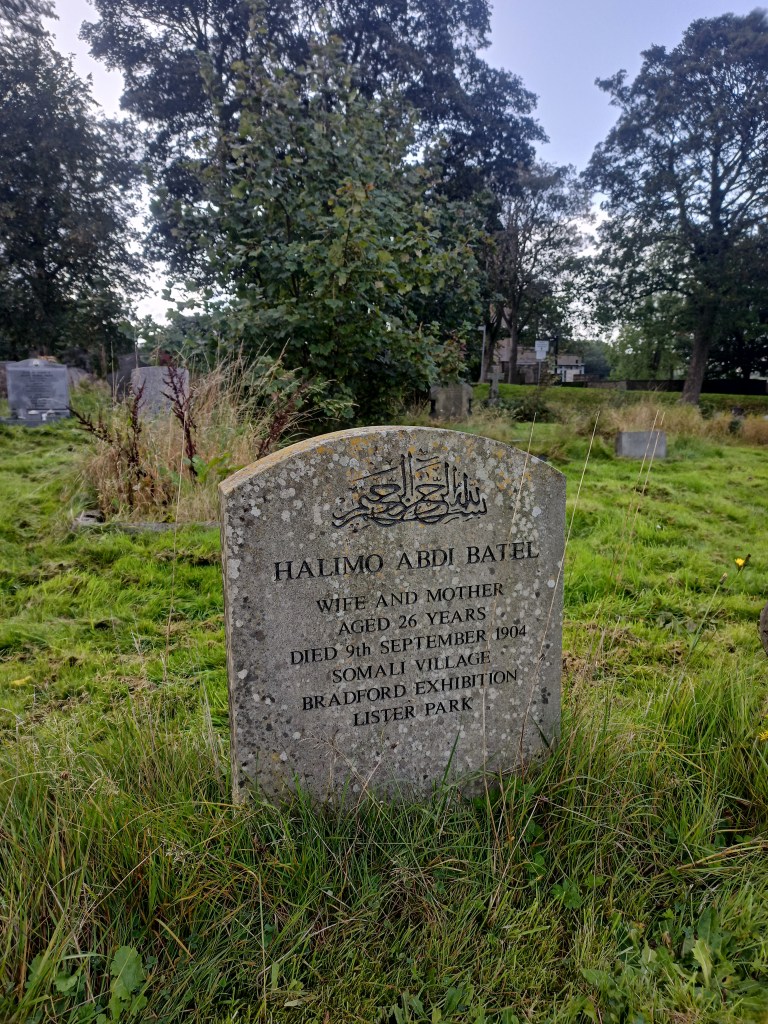
To our knowledge, Halimo Abdi Bādil or Badal (1878‒1904) is the first Muslim buried in Bradford. However, this Muslim woman was not from South Asia as one might have assumed but from the Horn of Africa.
On her death certificate as well as on her headstone in Scholemoor Cemetery, her name is not only misspelt as “Batel”, but there is a question whether “Batel” itself was correctly attributed to her or not. It may have been misattributed to her as a married family name by the registrar, rather than, as part of the Somali three-part naming convention, a combination of one’s personal name with the first names of one’s father and one’s paternal grandfather, when it was her husband’s father’s name. Alternatively, it could have been correctly attributed to her as her grandfather’s name, with her husband potentially being a first cousin or sharing a common name. Whatever the case, “Bādil” or “Badal” is a Somali-Arabic term for a child born as a spiritual or symbolic replacement for an older sibling who has died (its literal meaning is “substitute”).[1]
Halimo was part of a Somali ethnographic troupe, the most popular one of the “entertainments”, as they were called at the time, which appeared at the Bradford Great Exhibition of 1904 for six months in Lister Park (for more, see The Somali Village in the 1904 Bradford Exhibition).
Halimo died young at the age of 26 from tuberculosis, leaving behind a husband, Awad, and a young child, whose gender or age are unrecorded in the Yorkshire press. Halimo’s death at the camp caused discomfort in the local press. It was claimed that she had contracted tuberculosis on a previous visit to England in the 1890s, as part of Carl Hagenbeck’s African Exhibition of 1895 at the Crystal Palace in Sydenham, London, where a troupe of 66 Somalis had performed as riders of camels and horses.[2] It was not uncommon for Somali individuals of the carwo (“people of the fair”) to move between troupes. If the story is true that Halimo had come to Europe before, then she would have been only 17 the first time she came. The press asserted that Halimo had never fully recovered from tuberculosis after returning home to Somaliland in 1895, and that her illness had resurfaced when the troupe arrived in Marseille, where they underwent a medical check by a port doctor (whose logbook survives in the Marseille archives, which are yet to be checked). Halimo was said to have developed a cough by the time she disembarked at Marseilles on 24 February, but she insisted on remaining with the troupe,[3] which then appeared in Nice and then Marseille, France, until the end of April.
After arriving in Bradford, the weather was particularly cold in May and June,[4] and Halimo’s health deteriorated. On 17 May, a local medic, Dr Burnie, was called in to attend on Halimo after she suffered a seizure,[5] but she remained sufficiently unwell to remain confined alone indoors in the Village – this reflected the traditional Somali practice of isolating individuals with infectious diseases. She remained in isolation in the care of the troupe and the oversight of Dr Mossop and staff who volunteered with the St Johns Ambulance Service until her demise.[6] Her body did not leave the sight or care of the community at any point from end-stage illness to death to burial.
Halimo died in the early hours of 9 September and within 15 hours she was buried with full Islamic rites that same evening, after sunset, at Scholemoor Cemetery in Bradford. No one but the Somalis were allowed to touch her body: the women washed and shrouded her, placed her on a bier and covered her over with a pall. Offering prayers for Halimo, the women and her widower Awad watched over her constantly while the men would visit to offer prayers.[7] Just before 6 pm when Halimo’s body was about to depart, the entire Village gathered to hear the Mullah recite the Quran over Halimo’s body. Six Somali men then carried the body from the northern end of the Village where the residential huts were to the private park entrance on Emm Lane, followed by the whole Village. Halimo’s body was placed on a horse-drawn hearse provided by the local police. The funeral cortege was formed of the hearse, followed by a cab carrying Halimo’s husband, Awad, Sultan Ali, the leader of the troupe, and the Mullah, followed by a wagon carrying seven other Somali men. Following up at the rear was a separate cab for Captain Hastings, translator and manager of the Village, Mr. Singer, Secretary of British and Continental Enterprises, the company that ran concessions at the Bradford Exhibition, including the Somali Village, Police-Inspector Robbins, and John Gill, a member of the city council’s Exhibition Executive, and presumably members of the local press. The three-mile route the cortege proceeded on to the cemetery took an hour. On Emm Lane, it made its way down the hill, then headed south on Manningham Lane, turning westwards onto Carlisle Road, then turned south on Drummond Road, Whetley Hill, St Nicholas’ Road and across Thornton Road onto Preston Street, before turning westwards along Legrams Lane seeing green fields before turning off on to Necropolis Road to the cemetery.[8] The attempt to keep the funeral private failed, no doubt in part because the long route through the city must have attracted attention. Around 200 people had gathered near the prepared grave in the cemetery’s unconsecrated section and had to be kept at a respectful distance by several police officers.
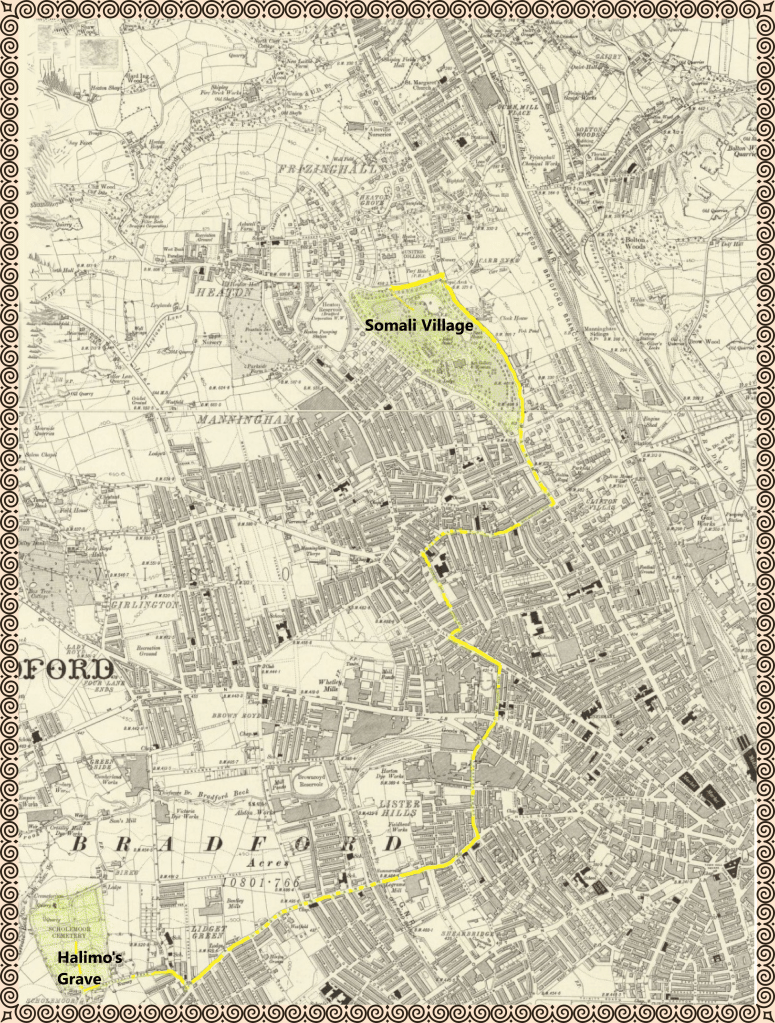
On arrival, Halimo’s body was taken from the hearse and placed on the ground facing Makkah. The Village Mullah led the funeral prayer, with the men lining up behind in two rows. Gratitude was expressed that, by Allah’s benevolence, Halimo had died on a Friday, which meant she would go to Paradise. The mourners raised and carried Halimo’s shrouded body carefully to the grave, which was dug to eight feet with boards placed at the bottom. She was lowered onto them. Her widower, Awad, and one other Somali man were inside to remove the outer pall and arrange her shrouded body appropriately. The Islamic custom is to lay the body on its right side, facing Makkah. This was impossible in this instance as Halimo’s grave like others in the unconsecrated section is lined up north to south (ideally the grave would have been aligned north-east to south-west, so the body could face south-east). Clay purified by water was placed around her body and then wooden planks set at an angle were placed over her to keep the soil out. During all this, and as the soil was shovelled on top by the Somali men, supplications were made by the Mullah, and the men constantly repeated the Fourth Kalima as they did so.[9] The whole ceremony concluded after an hour, at around 8 pm, by which time it was so dark that the only light available was a police bullseye lamp.[10] Two days before they left Bradford for good, 12‒14 men of the Village went to pay their last respects at Halimo’s graveside.[11]
Halimo’s grave remained unmarked for a century (plot number Sec.J, No.682, Unconsecrated, lying about 100 metres south-west of the now disused Crematorium), until historians Christine Hopper and Farena Bashir at Cartwright Hall re-identified it. A headstone was installed at the centenary of her death in 2004, paid for by funds held by Bradford District Museums and Galleries to commemorate the centenary of the Great Exhibition in Lister Park. The Telegraph & Argus reported at the ceremony to mark the headstone’s installation that “Scholemoor Cemetery’s Muslim registrar Abdul Haq Pandoor and his deputy Muhammid Riaz, said a prayer over the headstone inscribed with a verse from the Koran.”[12] In fact, the headstone has only the Basmala in cursive Arabic calligraphy, or the verse opening chapters of the Qur’an, by way of religious inscription.
بسم الله الرحمن الرحيم
HALIMO ABDI BATEL
WIFE AND MOTHER
AGED 26 YEARS
DIED 9th SEPTEMBER 1904
SOMALI VILLAGE
BRADFORD EXHIBITION
LISTER PARK
The inscription gives little further information about those she left behind, such as their names, which reflects the relatively poor state of knowledge about the Somali Village troupe members in 2004.
While it is true that the impresario, Victor Bamberger, who had recruited the Somali troupe, was prone to promote births for business reasons as he did elsewhere, e.g. in Mannheim, Germany, in 1907,[13] there may be grounds to believe that he promoted the birth of a girl in the Village two days later even more than he might otherwise have done. Questions could linger over the question of whether adequate shelter and medical care had been provided to the Somalis given Halimo’s death. Thus Bamberger and the City Council had a motive to distract the public’s attention away towards a more positive news story. Handbills were distributed around the city announcing the imminent birth, the silencing of the guns at the Port Arthur naval display on the adjacent lake, and the firing of the same guns if a girl was born. This was something that was characterised at the time by the local satirical magazine, The Jackdaw, and the Bradford Daily Telegraph, as a form of overkill.[14]
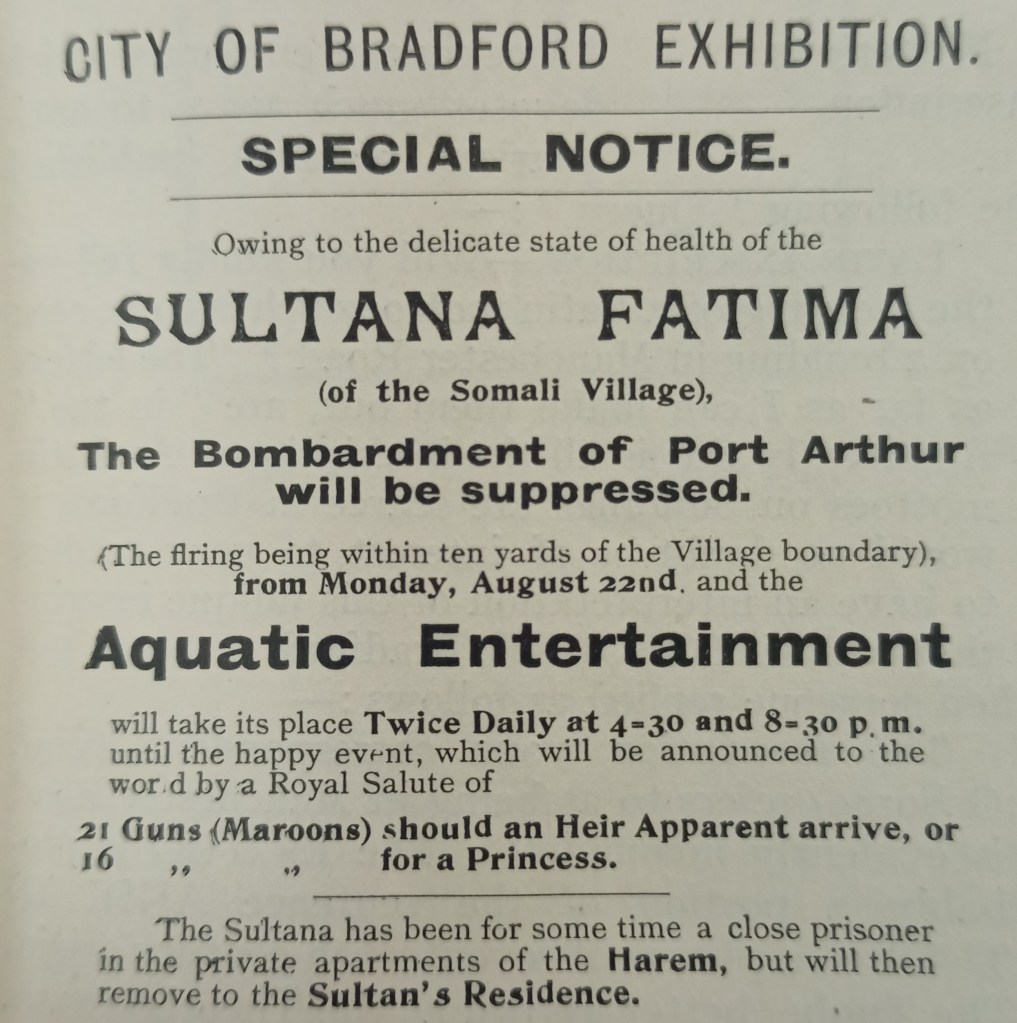
On his last day in the city, after the Exhibition had ended and the Village had been dismantled, Sultan Ali even hinted to the Bradford Daily Telegraph that the child was not his at all, but for promotional purposes the idea of a Somali princess named after the county was the story put out, i.e. the birth of Princess Hadija “Yorkshire”, whose arrival is announced with a sixteen-gun salute.[15]
Yahya Birt is a community historian of early Muslim life in Britain.
References
[1] Information supplied by the Somali historian, Bodhari Warsame.
[2] Bodhari Warsame, “A Brief History of Staging Somali Ethnographic Performing Troupes in Europe, 1885‒1930” in D. Demski and D. Czarnecka ( eds.) Staged Otherness: Ethnic Shows in Central and Eastern Europe, 1850–1939 ( Budapest: Central European University Press, 2021), pp. 77‒100.
[3] Bradford Daily Argus, 9 September 1904, p. 3; Leeds Mercury, 10 September 1904, p. 6.
[4] Bradford Daily Telegraph, 7 May 1904, p. 3; Leeds Mercury, 11 May 1904, p. 5; Bradford Daily Telegraph, 8 June 1904, p. 6; Bradford Weekly Telegraph, 25 June 1904, p. 6.
[5] Bradford Daily Telegraph, 17 May 1904, p. 3.
[6] Percy Lodge, Hon. Surgeon and Chief Superintendent Bradford Corps, St Johns Ambulance Brigade Cartwright Exhibition 1904 Report, 12 November 1904, WYAS Bradford 68D88-14-14; Bradford Daily Argus, 9 September 1904, p. 3.
[7] Bradford Daily Argus, 10 September 1904, p. 5; Yorkshire Post, 10 September 1904, p. 3.
[8] The route was reconstructed using the detailed description in Bradford Daily Argus, 10 September 1904, p. 5 and from the Ordnance Survey Six-Inch Edition maps of 1909, which surveyed Bradford in 1905‒6.
[9] The Fourth Kalima or the Supplication of Monotheism (Du’a’ al-Tawhid) is only partially reproduced in the Bradford Daily Argus press report (10 September 1904, p. 5), with a garbled translation and Arabic transliteration. However, there is enough text reproduced to assert with confidence that it is the opening of this particular litany, of which this is one variant: لَا إِلٰهَ إِلَّا ٱللَّهُ وَحْدَهُ لَا شَرِيكَ لَهُ، لَهُ ٱلْمُلْكُ وَلَهُ ٱلْحَمْدُ، يُحْيِي وَيُمِيتُ، وَهُوَ حَيٌّ لَا يَمُوتُ أَبَدًا أَبَدًا، ذُو ٱلْجَلَالِ وَٱلْإِكْرَامِ، بِيَدِهِ ٱلْخَيْرُ، وَهُوَ عَلَىٰ كُلِّ شَيْءٍ قَدِيرٌ. [Lā ilāha illā Llāhu waḥdahu lā sharīka lahu, lahu ’l-mulku wa-lahu ’l-ḥamdu, yuḥyī wa-yumītu, wa-huwa ḥayyun lā yamūtu abadan abadan, dhū ’l-jalāli wa’l-ikrām, bi-yadihi ’l-khayr, wa-huwa ʿalā kulli shayʾin qadīr.] “There is no god but God, alone, without compare. His is the dominion, and His is the praise. He gives life and causes death, and He is the Ever-Living who never dies, forever and ever. He is the Possessor of Majesty and Bounty. In His hand is all good, and He has power over all things.”
[10] Bradford Daily Argus, 10 September 1904, p. 5; Bradford Daily Telegraph, 10 September 1904, p. 5.
[11] Bradford Daily Telegraph, 31 October 1904, p. 2.
[12] “Centenary Stone for Halimo’s Grave”, Telegraph and Argus, 25 June 2004, https://www.thetelegraphandargus.co.uk/news/8001282.centenary-stone-for-halimos-grave/, accessed 20 February 2025.
[13] An infant Somali girl was given the name “Aurelah Mannhemia” after Mannheim in August 1907 under Victor Bamberger’s direction, see Marion Jourdan, “Koloniale Spektakel, kosmopolitische Kontaktzonen: Völkerschauen in Mannheim” [Colonial Spectacles, Cosmopolitan Contact Zones: Ethnographic Exhibitions in Mannheim], in Bernhard Gißibl and Katharina Niederau (eds), Imperiale Weltläufigkeit und ihre Inszenierungen: Theodor Bumiller, Mannheim und der deutsche Kolonialismus um 1900 [Imperial Cosmopolitanism and Its Stagings: Theodor Bumiller, Mannheim, and German Colonialism around 1900] (Göttingen: Vandenhoeck & Ruprecht, 2021), pp. 291‒335 (p. 321).
[14] Bradford Daily Telegraph, 14 September 1904, p. 2; The Jackdaw (Bradford), 1 Sept 1904, Vol. 1, No. 21, p. 3 (WYAS Bradford 67D85).
[15] Bradford Daily Telegraph, 31 October 1904, p. 3.
 Somali Village