Yahya Birt
A Tale of Exploitation
From 23 November 1912 through December, a second Somali Village came to Bradford eight years later in very different circumstances to the first one that had appeared as the star attraction in the Great Bradford Exhibition of 1904 (see The Somali Village in Bradford: An Introduction). This second troupe was part of the launch of a short-lived indoor circus called the Coliseum Fun City, which was at the junction of Toller Lane and Fairbank Road in the north-western part of the city (see map). This was part of the redevelopment of the rear section of a former ice rink; the front section had been refurbished as a 1250-seat cinema, the Coliseum, that had opened six weeks earlier. The Somalis appeared on the bill with American and European circus performers and a menagerie, a “Zoological Promenade of Wild Beasts”. They performed for long hours, late into the evening until 10.30 pm.[1] A local website, “Bradford Timeline” notes some local oral history that “There is a story that in the years leading up to the First World War (in 1914) and to promote the Circus, two Zulu warriors would stand at the entrance and utter weird cries and charge among the youngsters with their spears and shields.”[2] It cost tuppence or two pennies to enter the show, about 80 pence in today’s money.
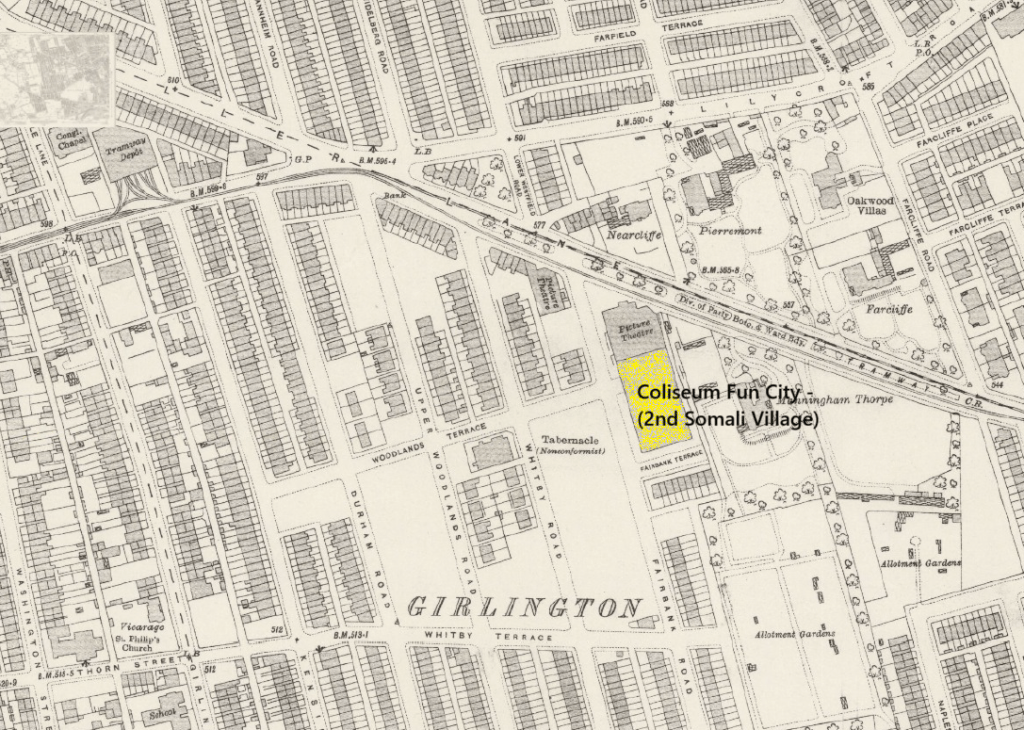
However, the Somali Village became quickly mired in controversy. On 13 December, the circus owner, W.H. Marshall, “a well-known show proprietor”, was fined at the City Police Court for housing the 23 Somali adults and their 10 children in a storeroom on the stage of the former rink with little or no ventilation and bad sanitary arrangements. All the troupe’s cooking and cleaning was being done in a small basement room. Marshall had applied to house them in the storeroom under the Public Health Act of 1890 and local bylaws on 23 November but that proposal had been rejected. When the Medical Officer came on 4 December, he saw that Marshall had ignored the order to provide better accommodation, which he did later on, placing them in caravans. Marshall was fined 40 shillings and 7 pence.[3]
Another case heard and dismissed on 30 December by a Bradford magistrate reveals that food was scarce for the troupe and had to be strictly rationed due to meagre income. The case was conducted through the current Village manager, a Greek man named Meyer, who translated from Somali or Arabic (the press reporting does not specify), as neither the accused nor the victim spoke English. An altercation had arisen between the “cook-man”, Ahmad Samatar, 30, and the younger blacksmith, Buux Warsame, over the latter taking a second portion of rice when the remainder had been reserved for the troupe’s women and children. Samatar had injured Warsame when the cook refused to give him more rice, later ambushing him the next morning by hitting him on the back of the head with the stick used to stir the rice, knocking him down and causing a contusion. The magistrate ruled in rather racializing terms that this was “nothing more than a tribal fight” and asked the two men to make up to be discharged.[4] The troupe also had to procure its food and purchase and slaughter sheep at the St James’ Slaughterhouse in Bradford.[5] It is unsurprising, given these difficult conditions, that the troupe was seeking employment elsewhere and their current manager, Meyer of Toller Lane, Bradford, placed an ad in London’s The Era for a Somali Village consisting of 32 men, women and children that was “now open for engagements”.[6]
The Tour Around Britain and Ireland (1911‒1912)
This troupe had arrived in Britain at least eighteen months earlier under a different manager, Muhammad Hamid, an Arab who had worked as an interpreter for Lord Kitchener at the Battle of Omdurman in 1898 during the Anglo-Egyptian conquest of the Sudan. Later on, he became an organiser of ethnographic shows in his own right. Overall, the press reporting is imprecise but the indications are that while this was presented as a Somali group, it was a mixed troupe comprised of Somalis (reports say they are from the Issa Tribe from Kenya, and the Habr Awal Tribe from British Somaliland) as well as of Arabs (variously described as Egyptian or French Algerian).[7]
There are gaps in the timeline of this troupe’s itinerary in the British Isles but, as so far we know, they first appeared between May–Oct 1911 at the Coronation Exhibition, Great White City, Shepherd’s Bush, under the patronage of British-Hungarian impresario, Imre Kiralfy (1845–1919), a former dancer who had worked with the famed American circus showman, P.T. Barnum, who went on to stage theatrical spectaculars in America and then grand imperial exhibitions in London (at Earl’s Court and later at White City).[8] During all stages of its tour, this troupe presented Somali village life in indoor spaces rather than outdoors like the Somali Village in Bradford had done in the 1904 Exhibition. This troupe, which at the time consisted of 60 men, women and children, then appeared in mid-January–April 1912, in Oxford Street, central London. From 5th August to early September 1912, they were at the Onchan Head Pleasure Grounds and Winter Gardens, in Douglas, Isle of Man, by which time their number had dwindled to 40 men, women and children. From 28 Sept‒9 Oct 1912, they were at the Rotunda Rink, Dublin. While in Dublin, they applied to appear at the Belfast Exhibition Hall but were rejected by the city’s council.[9] A Somali wedding was performed successively in Oxford Street, central London, Douglas and Dublin; the first performance of the wedding in Oxford Street got national press coverage, which featured a dramatic showbiz backstory about a dowry lost and a marriage delayed until London because of raiding allies of the “Mad Mullah”. Due to this success, it became the lynchpin in promoting the troupe on other legs of the tour, except for Bradford.
The Somalis at the 1911 Coronation Exhibition
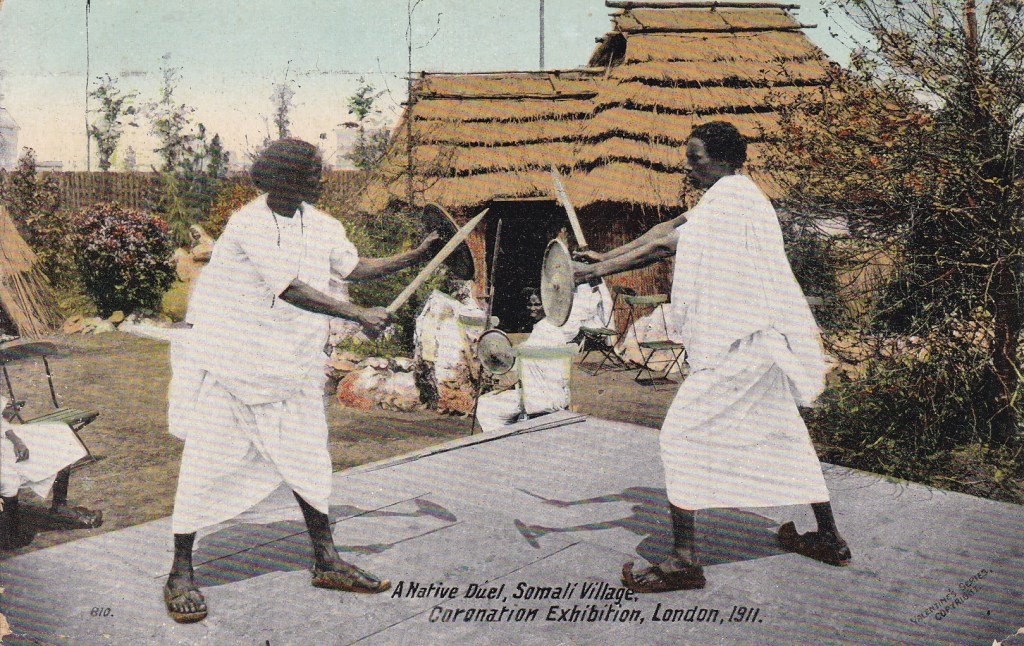
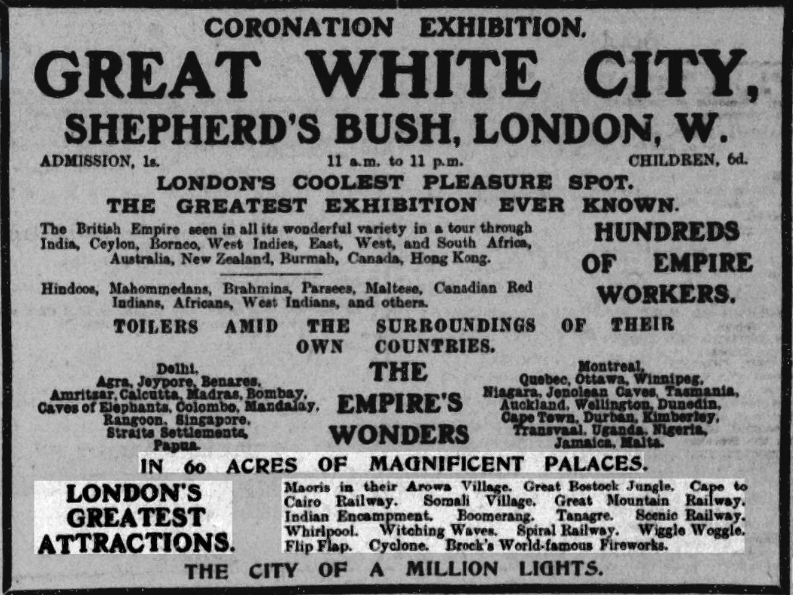
Imperial exhibitions in Britain reflected “national obsessions, character and morale” shifting from the mid-nineteenth century focus on industrial supremacy to “imperial and colonial display” that reached a peak in the first decade or so of the twentieth century up to World War One, before tailing off altogether after the Second World War. The Coronation of George V in 1911 marked an apotheosis in British imperial culture at home, with three great exhibitions, one in Glasgow and two in London, the official Festival of Empire at Crystal Palace and Kiralfy’s commercial Coronation Exhibition in White City, organised upon the rationale according to one Yorkshire reporter that “If you cannot take the people round the Empire, bring the Empire to the people.” Both put on grand imperial pageants to mark the Coronation: at Crystal Palace a train ride wound its way through the Dominions, showing tableaus from Newfoundland, Canada, Jamaica, Malaya, India, Australia, New Zealand and South Africa, while Kiralfy’s 140-acre strongly Orientalist pastiche with its white stucco palaces and pleasure gardens featured elaborate ceremonies with imperial subjects pledging fealty to the newly-crowned King. Both featured rival Somali troupes: at Crystal Palace, back for the third time, was Carl Hagenbeck’s ethnographic troupe under Hirsi Egeh Gorseh, while at White City was Muhammad Hamid’s troupe. Kiralfy kept the entrance fee low at 1 shilling a head, with children paying sixpence. The Somalis and all the other “natives” worked 12 hours every day, finishing at 11pm in the evening.[10] Kiralfy’s theatrical vision was to stage a loyal Empire in a microcosm (see advert) in which the Somalis were an integral feature, as a contemporary description shows:
The Coronation year demanded a special effort and the response has been, appropriately enough, a striking representation of every part of the British Empire. The manners and customs, the products, and the industries of the King’s dominions are reproduced with remarkable effectiveness. Natives of other climes have been brought to Shepherd’s Bush, and there, amid faithful pictures of their own native surroundings, they carry on their work as if they were at home. The Hindoo in his village, the Somali in his quaint settlement, the Egyptian in his bright but sparsely furnished home are all brought before the notice of the visitor. These are not the side shows of the exhibition. They are integral parts of one big picture of the Empire, filling it in with replicas of prominent places and historic edifices and beauty spots. Thus also products of Canada, of South Africa, and Australia, their industries and their amusements, are worthily represented.[11]
In the weeks before George V’s formal coronation on 22 June, Kiralfy staged elaborate theatrical demonstrations of loyalty by British imperial subjects in which the Somali troupe played an integral role alongside other colonized peoples, which are worth describing in some detail. On 9 June, representatives of the “600 natives of various parts of the Empire” were gathered together at White City’s Congress Hall to dispatch “a loyal address of congratulation to the King and Queen on … the Coronation”, with each speaking of their “feeling of loyalty”, which included Muhammad Hamid, described as the leader of the Somali troupe, with the troupe chanting a salute to the monarch, “Hail to our great King”. The various peoples broke up into groups to sing “patriotic songs”, finishing with a round of cheering for the King. Kiralfy then promised to convey these pledges to the King and Queen via Adolphus, the Duke of Teck, whose father had married into the Royal Family. [12] In general, the Arab showrunner Hamid, acting as Somali troupe’s leader but often mistaken for the Somali tribal chief, was adept at capturing the attention of the press. He worked closely with the White City management to drum up newspaper coverage for the exhibition as a whole, rather than just for the Somali Village. Examples include his recommendation that English children take up the Somali dental hygiene practice of using the toothstick (siwak), a story that was widely syndicated, or taking the opportunity on an excursion organised for all “representatives of Overseas Dominions” to see London’s sites to hail the remains of the Scottish explorer of Africa, missionary and doctor, David Livingstone (1813‒1873) at Westminster Abbey by chanting Livingstone’s name and raising his spear. Hamid was not beyond using colourful turns of phrase to get that media attention, for instance, describing a summer storm with lightning as the “flashing glance of an angry god” and thunder as an “upheaval of the universe”.[13] On 30 September, Kiralfy sponsored a Sports Day at his White City stadium, where several hundred spectators watched the Somalis, Indians, Maoris, West Indians, Canadian Indians, Malays, and labourers (“coolies”) from Hong Kong, in which the Somalis and the Maoris won the most medals; the troupe leader Hamed won a cup for wrestling after a prolonged bout of 20 minutes with an Indian.[14]
Oxford Street, London, January-April 1912
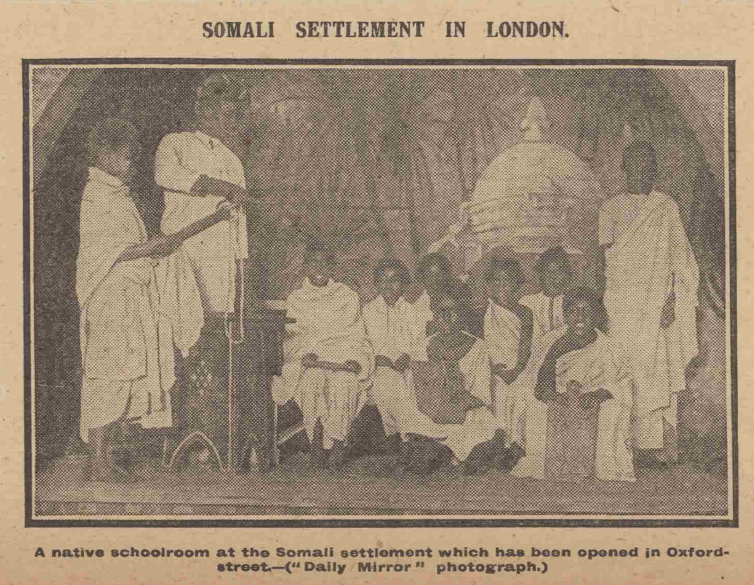
Having been so ubiquitous at the Coronation Exhibition, Hamed drops out of the press reporting, and it can be assumed that he was not part of the troupe’s subsequent tour around the British Isles. However, the whole troupe, numbering 60, remained intact from the previous year. In the first four months of 1912, it appeared in the heart of London’s shopping district in a large hall at 311 on the south side of Oxford Street between Bond Street and Oxford Circus, behind which was Hanover Square. Working 12-hour days up to 11 pm, an ethnographic setting of exotic but loyal imperial subjects was staged indoors as it was in White City, but without the former’s grand imperial pageantry. It was popular, attracting over 20,000 in the first week but slowing down to 15,000 over the following five weeks, which necessitated a marketing push in March. Unlike at White City, a greater emphasis was placed on exoticized, loyal imperial subjects who sold wares, performed with some theatrical elements, such as “an Eastern conjurer” and fire-eaters, and a staged wedding. Larded over with a racializing, imperial tone, these elements are captured in a description in the theatrical press:
In Oxford Street, a native settlement of sixty Somalis has been established for six weeks in order to show us how dusky subjects of King George live in a far-off clime. The visitor steps from the atmosphere of huge drapery stores into a Somali village, perfect to the smallest detail. There about the market-place stroll fine, handsome, frizzy-haired men clad in spotless white robes and carrying shields and spears. One need not have the slightest fear, however, for they greet us with broad smiles and offer us in the friendliest way pieces of soft wood [siwāk, toothbrush], such they use to keep their teeth white as their clothes.
Beyond is an enclosure where the warriors go through war dances, songs, and exercises. Around the hall are shops, a mosque where the Mullah presides at prayer, a school where the children are taught to recite the Koran, an Eastern conjurer, and natives at work as potters, leather fashioners, bakers, ironsmiths, basket-makers; the house of the Chief, Sheikh Essah and the Abyssinian dancing girls. In the gallery one may view this strange scene and take afternoon tea.[15]
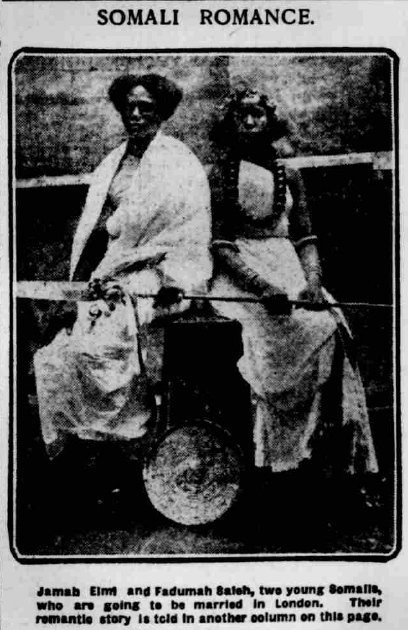
To stimulate visitor numbers further, a wedding was announced the first week of March. As well as selling an exotic ceremony, the marketing reinforced the narrative of loyal colonial subjects, whose daily lives were disrupted by anti-colonial resistance, as only the British Empire could guarantee their happiness, prosperity and security:
The sixty Somalis who are now encamped in a hall at 311, Oxford-street are celebrating a romance which is all their own. Jamah Elmi, a youthful spearman of the fighting tribe of Habr Awal, fell in love with seventeen-year-old Fadumah Saleh, the belle of the Essah Tribe.
Though a wanderer among Europeans for the time being, Elmi was a man of means in his desert home until, last December, a hostile tribe, enemies of the British Government, raided the pastures of the loyal subject of King George and looted his cattle. That meant that under the law of his race, the young man could not speak of his passion until he had retrieved his fortune.
What he lost in Somaliland he has practically regained in London, for the 35,000 visitors to the camp near to Oxford-circus have seen such generous purchasers of Elmi’s wares – ostrich feathers and so forth ‒ that he has been able to save a sufficient dowry, and, with the permission of the chief of his tribe, the Mullah can now wed the pair in their own little mosque with all the ceremony of the East.[16]
Douglas, Isle of Man, August-September 1912
A short stay of about a month from 5 August saw a reduced troupe of 40, advertised as coming “direct from White City”,[17] appear at the Onchan Head Winter Gardens, a north suburb of Douglas, the Isle of Man’s capital. Here, they worked 13 hours a day rather than the regular 12, tickets costing the standard rate of sixpence (half for children). The troupe was provided three unfurnished cottages with running water and working toilets.[18] On 3 September, the wedding was restaged as part of a local fundraising concert for children’s hospital cots. It was worth reproducing the description to show how much the wedding was reimagined as a public performance with invented additions:
After the concert an adjournment was made to the Somali Village, where a native wedding was celebrated between members of the Essa Tribe from Uganda, Almi Quabri and Medina Ahmed. The ceremony seemed very strange to European eyes, and created considerable interest. There was first a procession round the village led by Dervishes, Egyptians, Somali warriors, women and children. They sang a wedding march, and made a frightful row on tom-toms. The bride and the bridegroom (the latter escorted by two warriors) were then conducted to a raised platform, where the wedding ceremony was performed. It was mentioned that the bridegroom had had to pay for his bride, and that if he did not treat her well he would have to return to her the price he had paid. After a great deal of native talk, and the signing of deeds by the fathers of the young couple, their gowns were tied together and their hands joined under a shawl. Singing and dancing, fire-eating, etc. and a reception in the chief’s tent concluded the proceedings. An important part of the ceremony is the sacrifice of a sheep, which brought up the rear of the procession, but that part of the proceedings was postponed till the public had dispersed. Lady Raglan was presented with a bouquet at the concert hall, and with another on entering the Village. The bride and bridegroom were also presented to their Excellencies.[19]
Dublin, September-October 1912
After the Isle of Man, the troupe spent eleven days from 28 September, appearing at the Rotunda Rink in Dublin, where the wedding was again restaged. The troupe’s manager was unsuccessful in getting local aristocrats to attend the staged nuptials on 7 October as he had in Douglas, but the local press did cover the passing of felicitations while declining the invitation by the 12th Earl of Meath, Ireland’s last Lord Lieutenant of County Dublin.[20]
Conclusion
Bradford was the final stop in November and December of 1912, before the troupe disappears from the digital British press archive. After its appearances in London, this troupe was increasingly badly managed, with its tour organised ad hoc,[21] its employment precarious, and its members unprotected from unscrupulous employers who sought to exploit them beyond what few legal protections existed in Edwardian England. In these difficult conditions, it is unsurprising that the troupe had lost half its members during its tour and had changed managers. Currently, we do not know what happened to this troupe after Bradford or to the more than 20 members it lost before arriving in Yorkshire during its 1911‒12 national tour of the British Isles.
Yahya Birt is a community historian of early Muslim life in Britain.
References
[1] Advertisement, Leeds Mercury, 26 November 1912, p. 4.
[2] “Bradford ‒ Coliseum Cinema History”, Bradford Timeline, 2025. https://www.bradfordtimeline.co.uk/colise.htm.
[3] Bradford Daily Argus, 13 December 1912, p. 1; Yorkshire Evening Post, 13 December 1912, p. 7; Yorkshire Post and Leeds Intelligencer, 14 December 1912, p. 12.
[5] Bradford Weekly Telegraph, 20 December 1912, p. 2.
[6] The Era (London), 21 December 1912, p. 31.
[7] Daily News (London), 26 May 1911, p. 7; “Dark Athletes”, London Evening Standard, 2 October 1911, p. 11; Ripon Observer, 27 July 1911, p. 8; Sporting Life, 31 May 1911, p. 16; South Wales Echo, 7 March 1912, p. 3; Bradford Telegraph and Argus, 30 December 1912, p. 1; Shipley Times and Express, 3 January 1913, p. 7.
[8] Javier Pes, “Kiralfy [formerly Königsbaum], Imre (1845–1919), dancer and impresario”, Oxford Dictionary of National Biography, 23 September 2004, https://www.oxforddnb.com/view/10.1093/ref:odnb/9780198614128.001.0001/odnb-9780198614128-e-53347, accessed 24 February 2025.
[9] Belfast News-Letter, 10 October 1912, p. 4.
[10] “Coronation Exhibition 1911” in John Griffiths (ed.) Empire and Popular Culture (Abingdon, Oxfordshire, Routledge, 2022), 4 Vols, Vol. II: Empire in the public sphere: exhibition, spectacle and entertainment, pp. 146‒148; John MacKenzie, “The Imperial Exhibitions of Great Britain” in Blanchard, Pascal et al (eds.) Human Zoos: Science and Spectacle in an Age of Colonial Empires (Liverpool: Liverpool University Press, 2008), pp. 259‒268; Deborah S. Ryan, “Staging the Imperial City: The Pageant of London, 1911” in Felix Driver and David Gilbert (eds), Imperial Cities: Landscape, Space and Identity (Manchester: Manchester University Press, 1999), pp. 117–135; “Coronation Exhibitions”, Sheffield Independent, 25 July 1911, p. 7; Advertisement, Western Morning News, 27 July 1911, p. 3.
[11] “White City, the Coronation Exhibition at Shepherd’s Bush”, The Scotsman, 18 May 1911, p. 6.
[12] Aberdeen Press and Journal, 10 June 1911, p. 5; Cork Weekly News, 10 June 1911, p. 5; Daily News (London), 10 June 1911, p. 2.
[13] Daily News (London), 5 August 1911, p. 5; London Evening Standard, 27 July 1911, p. 7; Sheffield Independent, 26 August 1911, p. 12
[14] “Natives at Stadium”, The Referee, 1 October 1911, p. 10; Daily News (London), 2 October 1911, p. 3; “Dark Athletes”, London Evening Standard, 2 October 1911, p. 11.
[15] “Somali Settlement in Oxford Street”, Music Hall and Theatre Review, 7 March 1912, p.12; see also identical marketing copy provided to the local press, e.g., Kilburn Times, 1 March 1912, p. 6; St. Pancras Guardian and Camden and Kentish Towns, 1 March 1912, p. 7.
[16] “Somali Sweethearts: Romance of the London Camp”, South Wales Echo, 7 March 1912, p. 3; “Somali Romance in London: One Wife as the Beginning of a Home”, London Evening Standard, 7 March 1912, p. 5; “A Somali Romance”, Bradford Weekly Telegraph, 8 March 1912, p. 9.
[17] Isle of Man Examiner, 10 August 1912, p. 4.
[18] Isle of Man Examiner, 17 August 1912, p. 7.
[19] Isle of Man Times, 7 September 1912, p. 6.
[20] “Somali Wedding in Dublin: Wire from the Lord Lieutenant”, Dublin Daily Express, 8 October 1912, p. 2; “Somali Wedding in Dublin: Their Excellencies’ Felicitations”, Northern Whig, 8 October 1912, p. 12; Belfast News-Letter, 8 October 1912, p. 6; Evening Irish Times, 8 October 1912, p. 7.
[21] Isle of Man Examiner, 17 August 1912, p. 7; Belfast News-Letter, 10 October 1912, p. 4. The local authorities in Onchan were caught unaware and only heard about the arrival of the 40 Somalis at the last minute: “The Clerk said that an advertisement appeared in the papers a week last Saturday to the effect that a Somali Village was coming to Onchan Head. It seemed to have been a sudden engagement, as Mr Cubbin’s manager said the arrangements had only been made two or three days before.” The Belfast authorities turned down the Somali Village because of a double-booking at the Exhibition Hall in the city.
 Somali Village