Yahya Birt
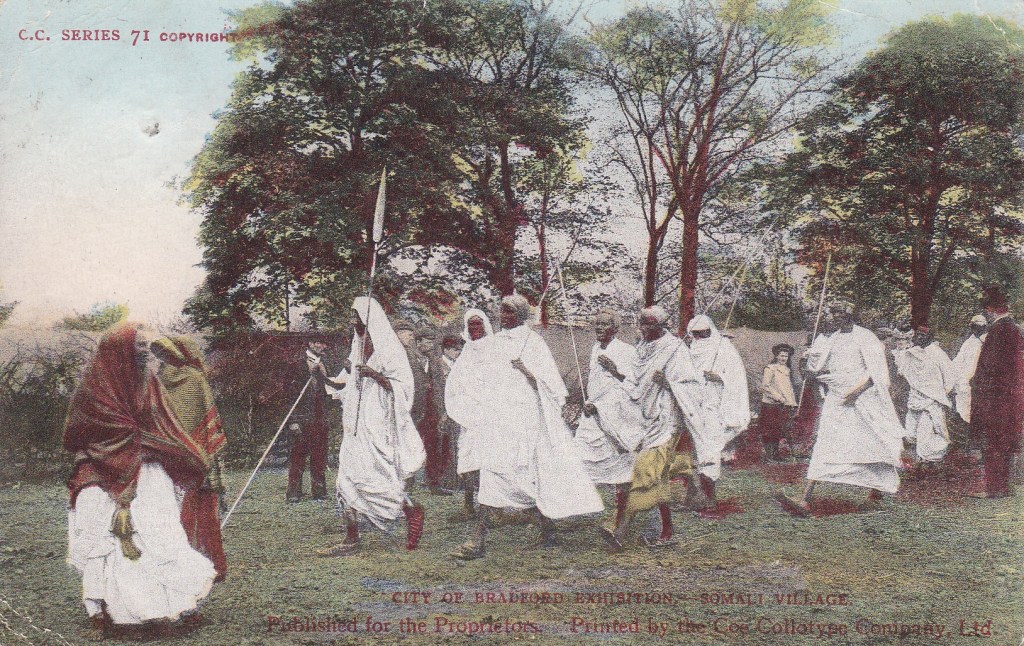
The Sultan Ali troupe
The Sultan Ali troupe that came to Bradford for the 1904 Great Exhibition was the second Somali ethnographic group in Britain after the Hersi Egeh Gorseh troupe that appeared at Crystal Palace in 1895 (see Bodhari Warsame’s article on Somali Troupes in Europe). Unlike the first troupe, which is the best documented, this project seeks to address the relative lack of knowledge about this second troupe visiting the British Isles. The Sultan Ali troupe may have originated from the Djibouti-Abyssinian/Ethiopian border, but this hypothesis has to be solidified, as the European press reports make different claims – the Yorkshire and French press in 1904 said it came from Somaliland, while the German newspapers in 1905‒6 said it came from Djibouti.
The troupe that came to Bradford comprised of 57 men, women and children,[1] although the marketing for the Village inflated that to a hundred, which was a common showbusiness practice. It was led by Sultan Ali al-Urfa (spelt “Orfur” in the German archive), a polyglot who already knew six languages (Somali, Arabic, English, French, Italian and German). This indicates that he had travelled widely, probably as a broker for European business interests, across Somalia during and after its colonial division in the 1880s and 1890s between the British, the French, the Italians and the Ethiopians,[2] well before first leading this newly-formed troupe to Europe in February 1904. In Bradford, Sultan Ali not only led the troupe, but held the role of Village Chief, and acted as its sole media representative.
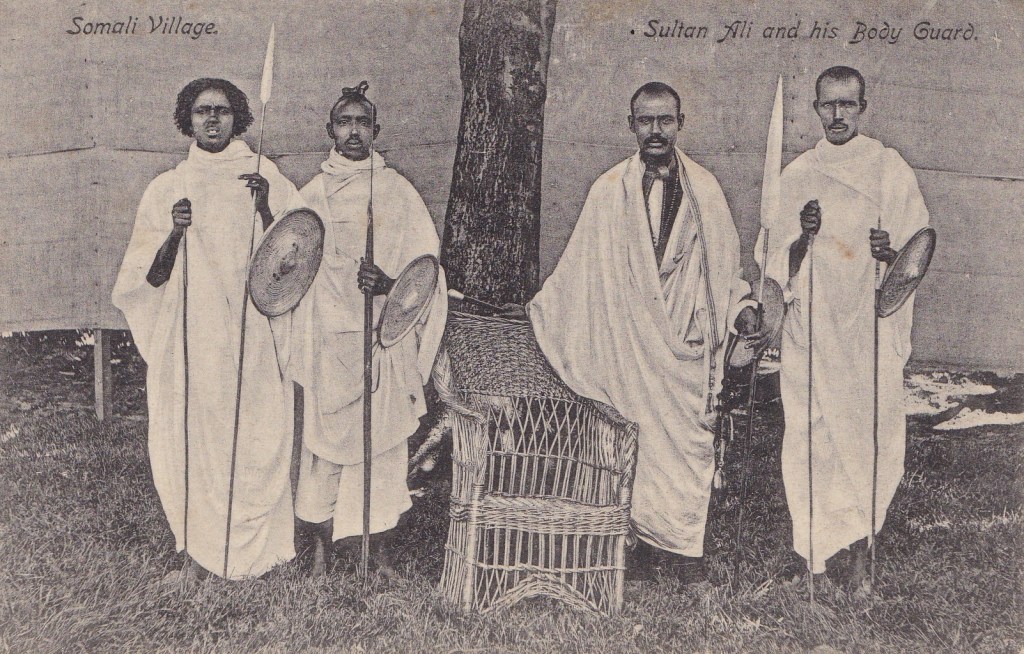
The Sultan Ali troupe’s first tour was set up in partnership with Victor Bamberger (1864‒1937), a Viennese businessman (for more, see Victor Bamberger, the Somali Village’s impresario). Originally, the “Ashantis” (a West African people from Ghana) had been booked to appear in Bradford, but when, for reasons unknown, that fell through, Bamberger proposed that he recruit some Somalis as last-minute replacements. Bamberger travelled with an ex-British officer and explorer, Captain Charles Holland Hastings (b.1860), who spoke Arabic and Hindustani (or Urdu),[3] to Aden in early January 1904 before crossing over to British Somaliland or Djibouti to recruit the Sultan Ali troupe.[4]
The troupe arrived in Marseilles from Aden aboard the SS Polynesien on 23 February 1904, where they underwent medical checks. They spent two months in France, first in Nice and then in Marseilles, where it was later claimed in the official catalogue of the Bradford Exhibition that the troupe had won the Bataille de Fleurs on 25th February, a competitive vehicular display of flowers, at the Nice Carnival, with the assistance of Bamberger’s wife. As this story does not appear in the local French press, it has yet to be separately corroborated and so should be regarded as showbusiness spin from Bamberger. In March, the troupe was in Nice, but details about their time there are scant. In the following month, they were put on display in the gardens of the Chateau-des-Fleurs (Rond-Point de Prado) in Marseilles between 3 April and 1 May; Bamberger later maintained that both Nice and Marseilles incurred losses for him, even though over 20,000 attended the Village during the Easter holidays. In general, compared to Bradford, press coverage (from available digitized archives) in Marseilles was very slight, while in Nice it was non-existent.
The troupe arrived in Bradford on 3 May in time to witness the inauguration of the Exhibition by the Prince and Princess of Wales. Not only was there full awareness of the colonial context of the Anglo-Somali War (discussed below), but it was commonplace, in a reinvention of Roman imperial culture, to stage colonial defeats involving the recently colonised peoples who had undergone these losses, using sensationalism to sell more tickets for commercial gain.[5] Bradford had previously, for three weeks in 1901, hosted Frank Fillis’ Savage South Africa show at Valley Park football fields in Manningham, which was a large re-enactment of the Boer War, while the real war in South Africa was still raging.[6]
As the Somali Village arrived in Bradford, Britain was in the midst of a war of imperial conquest in Somaliland. Following Somaliland’s imperial division by the French, Italians and the British in the late nineteenth century, Sayyid Muhammad Abdille Hassan (1864‒1920) led a twenty-year campaign of resistance by Sufis of the Salihiya Order, hence their nicknaming as “Dervishes”, against British colonial invasion. Between 1900‒4, the British mounted four major campaigns against Hassan, whom they dubbed “the Mad Mullah”. At the time, the Yorkshire press patriotically reported British progress and setbacks, as Hassan continually evaded capture, and scored the odd victory against the more heavily armed British.
The official Exhibition Catalogue in Bradford introduced the Somali troupe in a manner that showed full awareness and support for the imperial campaign in their home country:
[A] troupe of about 100 Somalis, from the Coast of East Africa, who are installed in Bradford after a very successful tour on the Continent. […] the Somalis are absolutely new and afford for the first time in this country an illustration of that little known but interesting people. The troupe consists of male and female natives, including adults and children, with a Native Chief and Mullah. Native customs, pastimes, occupations and ceremonies are shown; and among the demonstrations wrestling and spear throwing are especially entertaining. The title “Mullah” is given to their priest who accompanies them. He is not the identical Mullah upon whose head a price has been set by the British Government, but only one of a class of authorities occupying the position of tribal priest.[7]
When it was announced in April, before the Exhibition got underway, that the Somalis would serve as last-minute replacements for an Ashanti village, local fears were assuaged by the city fathers running the Exhibition, that the troupe were loyal Somalis who bore no connection with the Mad Mullah.[8]
The Somalis at the Bradford Exhibition of 1904
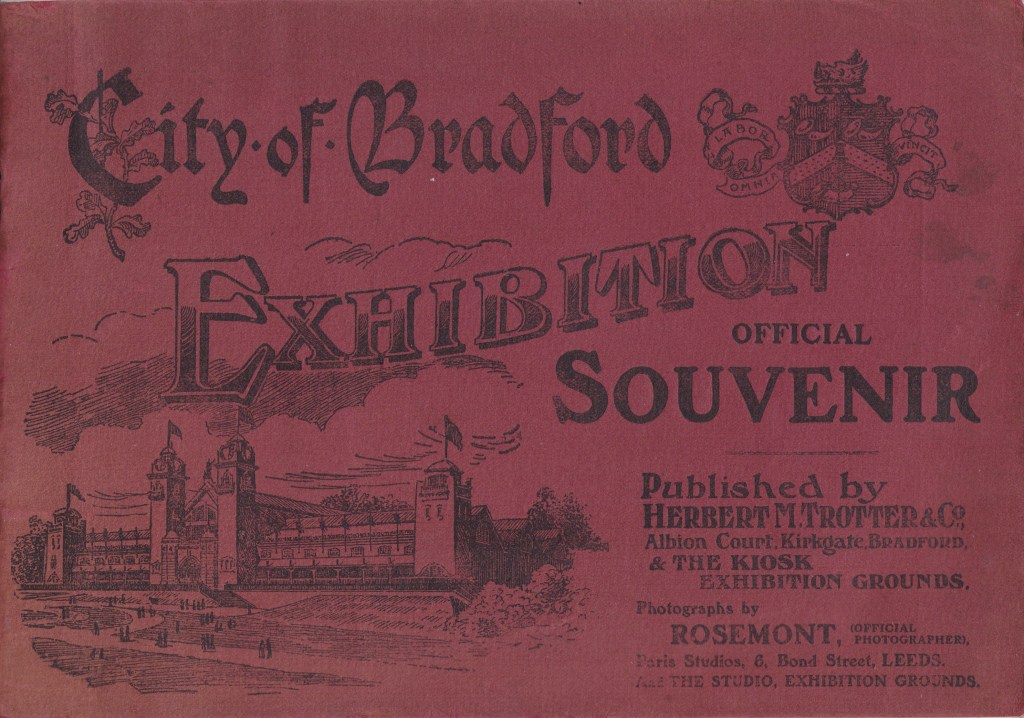
Running between May and October, the great Bradford Exhibition of 1904 was held in Lister Park, inaugurating Cartwright Hall and promoting Bradford’s businesses. Run by the city’s council, there were 2.4 million visitors and the Exhibition as a whole generated £14,965 in profits (some £1.54m in 2024).[9] Besides the huge, temporary Industrial and Concert Halls, and the newly inaugurated permanent art gallery of Cartwright Hall, there were concerts, sports and various entertainments and “funfair” rides. The Somali Village was the star attraction of what were called the “entertainments” provided at the Exhibition.
While the compound wall and the rustic painting inside the Village were built and designed by a local contractor, J.D. Waudby, the huts were built by the Villagers on arrival, using, it was claimed, authentic materials brought from Somaliland (although photographs, both official and unofficial, show the use of local materials as well). Charging a separate entrance fee, the Village attracted 363,134 visitors, and was by far the most profitable of the entertainments, generating a gross of £8,216, with 90% of tickets being sold at sixpence each (£2.54 in 2024 money). The Council retained a quarter of the Village’s profits after paying off the negotiated share to Bamberger and other concessions. Two-thirds of the remaining Somali Village profits (£2,054; in 2024 money, £209,000) went to help fund the art collection of Cartwright Hall, while the other third went to the Gas Corporation.[10] By comparison with the Village, the Water Chute made less than half that amount and the Crystal Maze, an eighth. On average over its six-month lifetime, the Village had 2000 visitors daily, although in reality there was a mix of busy days on weekends and holidays with quiet weekday ones.
Like the other touring ethnographic shows (Völkerschauen or “people shows”) developed in the late nineteenth century by Carl Hagenbeck (1844‒1913) and others who followed him like Victor Bamberger, the Village was a mixture of everyday life (schooling, cooking, worship, market, crafts), performance (dancing, mock battles, singing and chants), and lifecycle milestones (for Bradford, a birth, a divorce and a funeral, while in other places, there were weddings, for example, earlier in France and later on in Germany). Part of the complexity of the Somali Village and other “ethnic shows” is that real life and artifice, authenticity and performance, were intertwined in every aspect of these “villages”.[11]
As the historian Bodhari Warsame notes, the chief mindset of the Somali troupes that came to Europe and America was business-orientated, as is reflected in the Somali term for these troupes, “carwo” (pronounced arwo), meaning “people of the fair or market”.[12] There were many other cases where colonised and racialised peoples were put on display in Europe who had been kidnapped, and children were at times “adopted” permanently into this life in murky circumstances, a practice that was the subject of court action.[13] However, the case of the Somali troupes was different. Both parties (in this instance, Bamberger and the Sultan Ali troupe at Bradford) expected to make money, but it was an asymmetric contract: the ordinary Somalis earned £7‒£12 (£713‒£1,222 in 2024 terms) for six months of long days with no breaks; those who practised crafts like weaving or metalwork or held a profession like the imam were paid slightly more. Sultan Ali earned £42 (£4,278 in 2024) for the whole duration.[14] Handicrafts like pottery and fabrics were sold, and the Somalis expected visitors to pay to take photographs, which could sometimes lead to disputes with those who took snaps without payment. The Yorkshire press characterised the Somali expectation of direct payment inside the compound satirically as “baksheesh”, which has a wide set of meanings ranging from a monetary gift, tip, bribe or donation.[15]
The more professionalised Somali troupes saw the ethnographic village tours as lucrative opportunities and a chance for adventure, but even for them it was only their determination, solidarity and professionalism that allowed them to confront considerable challenges. Bodhari Warsame summarises these as:
a racially charged, manipulative colonial environment …[where they] never lost their will to survive and to be agents for negotiating power. They also experienced their share of difficulties, including racial abuse, blackmail, overwork, fierce business competition within the troupe or with other ethnic troupes, culture and weather shock, ill health, death in strange lands, and staying away from home and close family for long periods.[16]
It is unsurprising then that these experiences were transformative for the Somali troupes generally, as well as for the troupe that came to Bradford in 1904. On the Somalis’ last day in Bradford, Sultan Ali remarked to the press that his troupe had been changed by their experience of touring in France and England, and were unlikely to return to their original occupation as shepherds.[17] This turned out to prophetic as the troupe, in various configurations, continued to tour Europe and North America over the next decade.
Yahya Birt is a community historian of early Muslim life in Britain.
References
[1] Le Journal (Marseille), 24 February 1904, p. 3.
[2] On Ethiopia’s imperial expansion into Western Somalia (the Ogaden region) in competition and sometimes in alliance with the European imperial powers in the late nineteenth century during the “Scramble for Africa” after the 1885 Berlin Treaty carved up the continent, see Richard Greenfield, “Towards an Understanding of the Somali Factor” in Peter Woodward and Murray Forsyth (eds.) Conflict and Peace in the Horn of Africa: Federalism and Its Alternatives (Aldershot: Dartmouth, 1994), pp. 103–114 (see pp. 105–6).
[3] See entry on “Hindostanee”, Henry Yule and A.C. Burnell, Hobson-Jobson: The Definitive Glossary of British India (Oxford: Oxford University Press, 2013 [1886]), abridged, ed. Kate Teltscher, p. 259.
[4] The Standard (London), 5 December 1907, p. 10.
[5] John MacKenzie, Propaganda and Empire (Manchester: Manchester University Press), Ch. 4: Imperial Exhibitions, pp. 96‒120; Guido Abbattista, “Beyond the Human Zoos: Exoticism, Ethnic Exhibitions and the Power of the Gaze”, Ricerche Storiche, Vol. 45, Nos. 1–2, 2015, pp. 207–217, citing n.13, Mary Beard, The Roman Triumph (Cambridge, Mass.: Harvard University Press, 2009), pp. 328–329.
[6] Norman Alvin, “Savage South Africa: The Prince, the Lion Skin and the Kidnapped Zulus”, The Bradford Antiquary, Vol. 85, 2024, pp. 1‒21.
[7] WYAS Bradford, 39D90/2, City of Bradford Exhibition May to October [1904] Official Catalogue, p.49.
[8] Bradford Daily Telegraph, 22 April 1904, p. 2; Yorkshire Post, 29 April 1904, p. 4; Sheffield Daily Telegraph, 2 May 1904, p. 8.
[9] WYAS Bradford 68D88-14-12 Managers Report and Statement of Accounts 1905, pp. 13‒19.
[10] Ibid.
[11] Hilke Thode-Arora, “Hagenbeck’s European Tours: The Development of the Human Zoo” in Pascal Blanchard et al (eds.) Human Zoos: Science and Spectacle in the Age of Colonial Empires (Liverpool: Liverpool University Press, 2008), trans. by Teresa Bridgeman, pp. 165‒173; Wemer Michael Schwarz, “Echte und falsche Menschen ‘Anthropologische Spektakd’ in Wien” [“Real and Fake People: ‘Anthropological Spectacle’ in Vienna”], in Kristin Kopp and Klaus Müller-Richter (eds.) Die ‘Großstadt’ und das ‘Primitive’: Text – Politik – Repräsentation [The ‘Metropolis’ and the ‘Primitive’: Text, Politics, Representation] (Stuttgart: Verlag J. B. Metzler, 2001), pp. 53‒67.
[12] Bodhari Warsame, “A Brief History of Staging Somali Ethnographic Performing Troupes in Europe, 1885‒1930” in D. Demski and D. Czarnecka ( eds.) Staged Otherness: Ethnic Shows in Central and Eastern Europe, 1850–1939 ( Budapest: Central European University Press, 2021), pp. 77‒100; Charles L. Geshekter and Said Ahmed Warsama, “An Introduction to Humour and Jokes in Somali Culture” in African Languages and Cultures. Supplement, No. 3, Voice and Power: The Culture of Language in North-East Africa. Essays in Honour of B. W. Andrzejewski (1996), pp. 141‒153 (p.145 n.4).
[13] For example, the Bradford Police Court in 1901 heard a summons by lion tamer Captain Frank Taylor against his employer, the showman Frank Fillis, for unlawfully detaining two Zulu boys, Gais Marlow, 12 and Marney Marlow, 10, see Alvin “Savage South Africa”, pp. 4‒5.
[14] Bradford Weekly Telegraph, 5 November 1904, p.6.
[15] Bradford Daily Argus, 9 May 1904, p. 3; Bradford Daily Telegraph, 24 May, p. 3; Shipley Times and Express, 10 June 1904, p.5; Bradford Daily Telegraph, 31 October 1904, p. 3.
[16] Warsame, “A Brief History”, p. 98.
[17] Bradford Daily Telegraph, 31 October 1904, p. 3.
 Somali Village