Fozia Bora
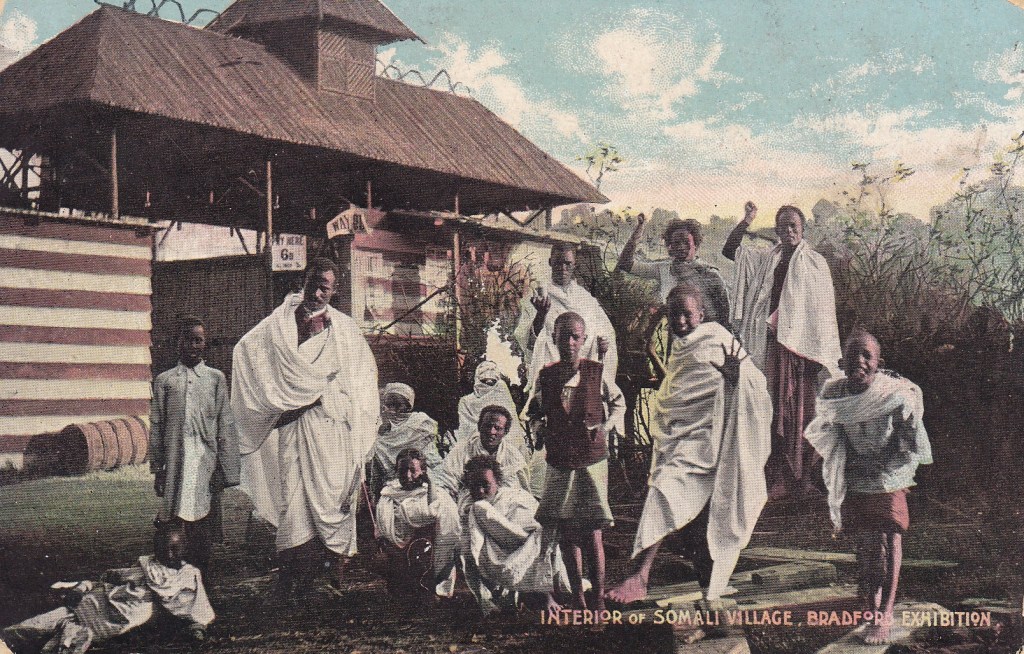
In 1904, the West Yorkshire city of Bradford – then a thriving industrial hub at the heart of global textile manufacturing – hosted one of the largest and most ambitious civic exhibitions of the Edwardian era. Attracting over two million visitors across six months, the Great Exhibition was a celebration of empire, commerce, technological innovation and civic pride, where the newest baby incubators were exhibited alongside musical entertainments and family-friendly fairground-style rides. Among its many attractions, one had a different character and left a different kind of legacy than the rest: the so-called ‘Somali Village’. This ‘model village’ stood out as the most popular feature of the Exhibition, drawing over 350,000 visitors. Advertised as a living ethnographic display, Somali men, women, and children performed and demonstrated daily activities, including cooking, prayer, dancing, mock battles, and crafts such as weaving and blacksmithing, selling their wares to visitors. This ‘village’ exemplifies one of many moments when Somali people, like other colonised, racialised, exoticised and commodified people, were staged as spectacle in Western cities. Yet on closer inspection, they were also actively engaged in shaping their own present and future pathways as travelling troupes negotiating the perils of exploitation by colonial impresarios in foreign lands, while engaging in artistic production, performance and assertion of their rights – where that was structurally possible.
To explore aspects of the history of the Somali Village in Colonial Bradford further, below is a list of short or medium-length articles written by members of our research team. As our research progresses, over time, we will add further material to this landing page for the project.
1. A Brief History of Staging Somali Ethnographic Performing Troupes in Europe, 1885‒1930 (Bodhari Warsame) [External, Open Access]
2. Critical Framings of the Somali Village (Fozia Bora) – Forthcoming
3. Somali Troupes in Ireland (Steph Dennison) – Forthcoming
4. The Somali Village in the 1904 Bradford Exhibition: An Introduction (Yahya Birt)
5. The Bradford Exhibition of 1904 (Chris Gaffney) – Forthcoming
6. Colonial Bradford, A Forgotten Legacy: An Essay in Five Parts (Yahya Birt)
7. The Archaeology of Bradford’s Somali Village (Chris Gaffney or Ben Jennings) – Forthcoming
8. A Timeline of Bradford’s Somali Village (Yahya Birt)
9. Victor Bamberger, the Somali Village’s Impresario (Yahya Birt) – Forthcoming
10. After Bradford: The Somali Village in Germany, 1905‒6 (Evelyn Kloos) – Forthcoming
11. The Fire at the Somali Village and the Town Hall Picket (Yahya Birt)
12. Death and Birth in Bradford’s Somali Village (Yahya Birt)
13. Religious Authority and Islamic Tradition in the Somali Village (Mohamud Awil Mohamed) – Forthcoming
14. Bradford’s Children Respond to the Somali Village Today (Sofia Fallon) – Forthcoming
15. Bradford’s Second Somali Village (Yahya Birt)
A Community-led Project
The Somali Village in Colonial Bradford (SVCB) project is a community-led academic and artistic response to this complex history. As a group of academics (from undergraduate students to professors to world-leading independent scholars), curators, artists and teachers, we aim to reclaim the story of the 1904 Somali Village not as a footnote of imperial display, but as a significant episode in the longer history of Somali migration, cultural expression and resistance. Through archival research, creative practice and public engagement, our project works to re-centre Somali voices in the telling of this history and to bypass and transcend the white colonial gaze that has traditionally framed it, relegating this gaze to the sidelines of our project, while acknowledging its salience.
In turn, this research project is part of the foundational work of Somali Village, a newly established and pioneering Somali-led heritage and education organisation launched in 2025. Somali Village is to become a registered charity created by members of the UK Somali community and their allies, dedicated to advancing research, education, and cultural production relating to the history of the Somali diaspora in Britain and globally. In this sense, the SVCB and Somali Village will work hand in hand to begin the wider exploration of global Somali diasporic history with the local and transnational history of Bradford’s Somali Village. (See our “About Us” page for more information about our Somali Village trustees, members and partners.)
Rethinking the Archive, Reframing the Gaze
While we resist the reductive framing of the Somali Village as a ‘human zoo’, a term coined in French academic scholarship on the racist and colonial phenomenon of ‘ethnographic’ display, our project trains its effort on illuminating the Somali experience of (voluntary) displacement, employment, exploitation, resilience, systems of self-care and growth and decision-making amongst troupe members. We aim not for re-display but for an epistemological reframing of this history to reverse the colonial gaze.
To do this, we begin with acknowledgement that in the British imperial context, the ‘archive’ often functioned as a tool of control, surveillance and racial codification. Indeed, to date, most research on the Somali Village has relied on local archives: official records, press coverage, exhibition documents and photos taken of the troupe in various poses and locations in their ‘village’ at the time, all authored through the white colonial gaze. These sources are valuable, but incomplete and painfully one-sided.
The SVCB project takes a decolonial approach to these materials: reading them critically, and against their grain, questioning their assumptions and looking for traces of Somali voices and perspectives. We interpret the concept of ‘archive’ liberally, as a living and growing repository of commemorative practices drawn from oral history, family stories, family photographs, artefacts and cultural memory preserved within Somali communities in the UK, the Horn of Africa and the wider diaspora. By working closely with Somali historians, elders, creatives and cultural experts, our project aims to construct a fuller, more balanced account of this history, one grounded in Somali experience and insight. More than a history lesson, this is an invitation: to rethink how we write history, who gets to tell it and whose stories are preserved in our museums, archives, public spaces and educational institutions.
How You Can Help
A key part of our project is to gain contributions from Somalis and all others who may have family memories, stories, poems, photos, postcards, memorabilia, objects or interpretations about this history. You can contact us here, via the website.
Supporting and Nurturing Somali Diasporic History in West Yorkshire and Beyond
The SVCB project benefits from support from the following institutions:
- University of Leeds
- University of Bradford
- Cartwright Hall Art Gallery (part of Bradford District Museums and Galleries)
- Bradford City of Culture 2025 (Bradford Made educational project)
- Bradford Literature Festival
- The Anglo-Somali Society
- Mustafa Mount Education (part of the Greensville Trust)
- Everyday Muslim
The SVCB research team members are:
- Abira Hussein (PhD candidate, University College London, heritage practitioner in Somali heritage and archives)
- Ben Jennings (Associate Professor, School of Archaeological & Forensic Sciences, University of Bradford)
- Bodhari Warsame (community historian; expert on the Somali ethnographic troupes/Gothenburg, Sweden)
- Chris Gaffney (Professor of Archaeological Science, University of Bradford)
- Evelyn Kloos (curator of 2005 Somali Village exhibition, Oldenberg, Germany)
- Fozia Bora (Associate Professor in Islamic History, University of Leeds)
- Mohamud Awil Mohamed (PhD candidate, History, Penn State)
- Stephanie Dennison (Professor of Brazilian Cultural Studies with special emphasis on contemporary film culture, University of Leeds)
- Yahya Birt (community historian; expert in early British Muslim history)
If you’d like to be involved, contribute your own story, or find out more about Somali Village’s work, please comment or contact us through our website. Together, we can build a richer, more inclusive historical record—one that honours the journeys, contributions and resilience of the Somali people across time and place.
Fozia Bora is Professor of Islamic History at the University of Leeds.
 Somali Village